

Summary
Key Takeaways:
Cotton remains a weather market, with sharper Texas deterioration providing support, but USDA's higher production and ending stocks estimates continue to cap rallies.
The July WASDE was mildly bearish for new crop, though strong export commitments and elevated abandonment risk in West Texas are keeping the balance sheet story alive.
Brazil's record coffee crop continues to cap sustained rallies, while delayed harvest movement and ICE arabica stocks at a 2.25-year low keep nearby squeeze potential intact.
Macro became less uniformly restrictive after a soft U.S. CPI print, but Brent's 12% surge on Strait of Hormuz risk reopens the inflation channel and limits how dovish the Fed can become.
Coffee retains the stronger near-term upside on tight inventories and second-half flowering risk, while cotton still needs visible High Plains yield losses to extend materially higher.
Technical Analysis
Read this week’s Technical Analysis here.If you want to understand the charts further, you can read about how to interpret them here.
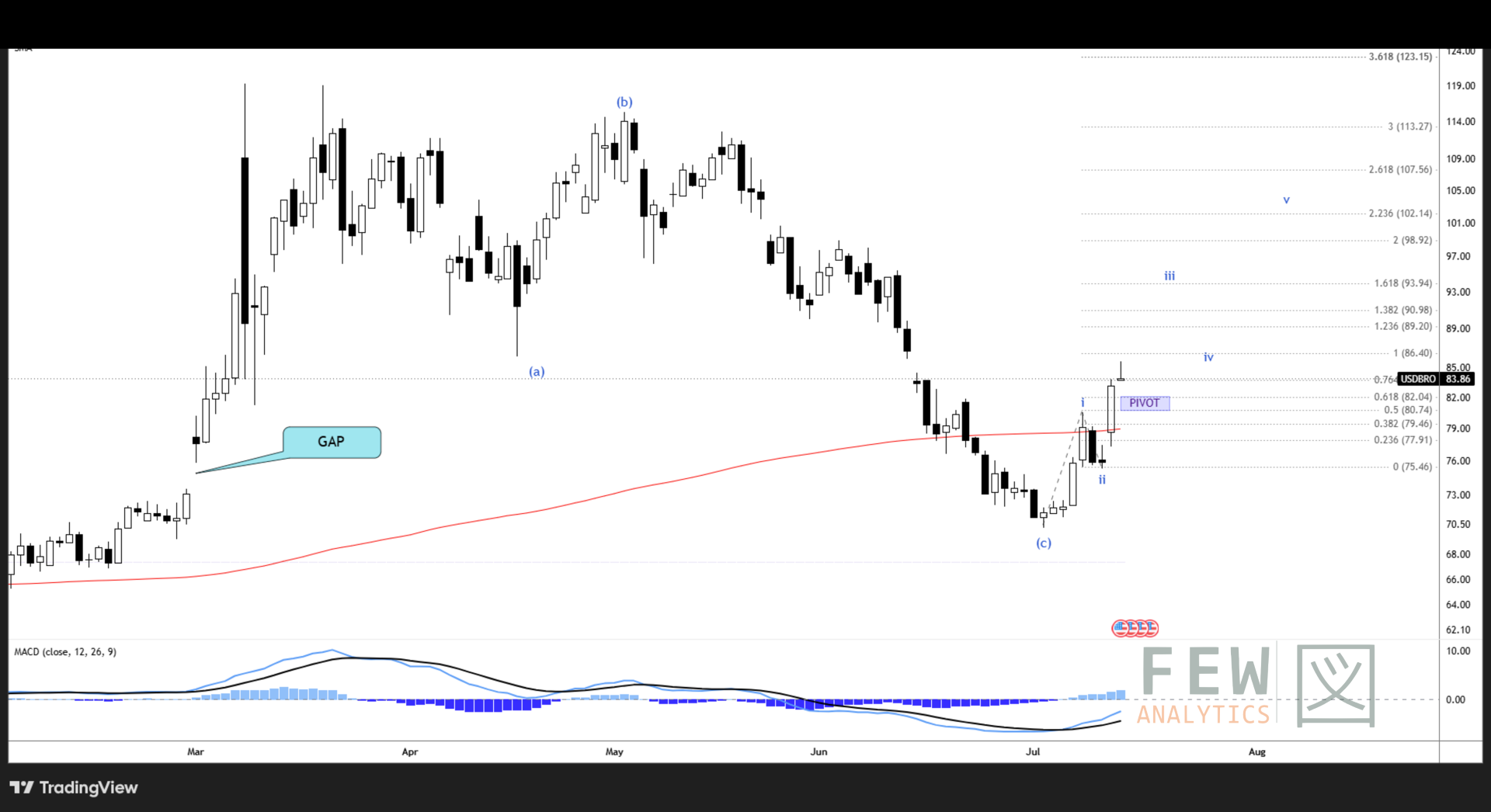
Chart of the Week - Brent is bullish on all timeframes
Big picture, Brent counts quite well as an ABC correction. We had been awaiting a fill of the gap around 74, which completed at the end of June. While the market traded a touch lower, we have since seen a strong rebound off that area — which may have ramifications for Middle East stability being upended once again. Since forming the bottom, we have seen a strong candidate for five subwaves up to 80.50, subsequently completing a 50% retracement for wave ii. Base case is that we are now in wave iii up to 94. We will need to see another vth wave to 100 to confirm we’ll see much higher oil prices into the end of 2026. This outlook remains valid above 80.

Cotton
Cotton remains a weather market, and this week delivered a clearer Texas warning rather than a clean bullish breakout. National squaring advanced to 60%, marginally ahead of the 59% five-year average, while boll setting reached 22%, exactly in line with average. Conditions deteriorated again, with national good/excellent falling to 44% from 46%, while poor/very poor held at 16%. Texas remains the key risk: the crop reached 50% squaring and 22% setting bolls, but condition dropped sharply to 30% good/excellent from 36%, while poor/very poor edged up to 24% from 23%. December cotton settled at 80.87c/lb on 14 July, retaining most of last week’s weather premium but still needing visible High Plains yield losses or increased abandonment risk to extend materially higher.
USDA’s July balance sheet pushed back against the weather story. U.S. 2026/27 production was raised by 400,000 bales to 13.7m, with planted area at 9.85m acres, harvested area at 7.54m acres and ending stocks lifted to 4.1m bales, equivalent to 29.5% of use. Globally, production was raised to 117.3m bales, mill use to 122.0m and ending stocks to 71.2m. The balance sheet still implies a supportive production deficit of approximately 4.7m bales, but the projected stock cushion is slightly larger than it was last month. Weekly Upland sales improved to 66,400 RB, up 36% from the previous week but still 49% below the prior four-week average. Shipments rose 5% to 230,100 RB, while new-crop sales reached 87,000 RB. Demand is holding together, but it is not yet strong enough to offset the higher USDA supply baseline.
Coffee
Brazil remains the coffee market’s record-crop anchor, but nearby trade continues to be driven by delayed harvest movement, tight arabica stocks and increasingly thin liquidity. USDA/FAS continues to forecast a record crop of 71.9m bags, while Sucafina’s private estimate is higher at 75.4m bags, including 49.4m arabica and 26.0m robusta. The latest Safras & Mercado reading still has harvesting at 52% complete as of 1 July, behind 60% last year and the 55% five-year average, with heavy rainfall disrupting fieldwork, increasing cherry drop and raising quality concerns. September arabica settled at 326.10c/lb on 14 July, below last week’s five-and-a-half-month high but still elevated, while two ICE margin increases have amplified the market’s recent volatility.
Tight deliverable supply remains the clearest nearby bullish input. ICE-certified arabica inventories declined to 339,652 bags, a 2.25-year low, while robusta stocks recovered to 4,220 lots from the May low of 3,631 lots. Weather risk has also broadened beyond the current harvest: Brazil’s Abic warned that El Niño-related heat and irregular rainfall could reduce expected production by 15%–20%, although expanded irrigation and improved farming technology should make crops more resilient than during previous events. This remains a risk scenario rather than a confirmed loss, and the size of Brazil’s crop continues to cap sustained rallies. Nevertheless, delayed movement, exceptionally low arabica stocks and uncertainty surrounding second-half flowering keep the potential for another squeeze alive.
Global Macro
Macro became less uniformly restrictive this week, although it has not turned decisively supportive. June U.S. CPI fell 0.4% month on month, the largest monthly decline since April 2020, slowing headline inflation to 3.5% year on year from 4.2% in May. Core CPI was unchanged on the month and eased to 2.6% year on year. The softer release pulled the U.S. 10-year yield back toward 4.58%–4.59% and the dollar index to approximately 100.8. Fed-funds pricing now assigns only around 10%–16% probability to a July hike, while the probability of a September increase has fallen to roughly 60%, from more than 90% before the CPI release. Rates remain restrictive, but the immediate risk of another near-term tightening move has eased.

Energy is sending the opposite signal. Brent has climbed back to approximately $85.5–$86.2/bbl, rising more than 12% this week as renewed disruption risk around the Strait of Hormuz rebuilt the geopolitical premium. Higher oil strengthens the polyester cost floor under cotton, but it also reopens the inflation channel and may limit how dovish the Federal Reserve can become. China added a separate demand concern, with second-quarter GDP slowing to 4.3% year on year, below the 4.5% consensus and the 5.0% first-quarter pace. Net-net: cotton now has a clearer Texas weather risk and stronger energy support, while coffee retains meaningful squeeze potential. However, larger projected cotton supplies, record Brazilian coffee production, still-elevated U.S. yields and softer Chinese growth continue to cap conviction in both markets.


Cotton
Cotton Price Action
ICE cotton held last week's recovery and pushed into resistance. December settled at 81.51 c/lb on Tuesday 14 July, October near 79.83, March near 82.94, May near 83.74. Against the 7 July closes that leaves December up 22 points and March up 26, a hold rather than a fresh leg after the prior week's 400-plus-point run.
The July WASDE was mildly bearish, raising 2026/27 production to 13.70 million bales and ending stocks to 4.10 million, a 29.5% stocks-to-use ratio. The board ignored it and traded the weather.
Cash firmed. The seven-market spot average rose 347 points to 72.98 c/lb for the week ending 9 July. Transactions stayed thin at 1,732 bales. Crop ratings eased to 44% good/excellent from 46%, with 60% squaring and 22% setting bolls. Record heat across West Texas is the bullish lever, and certified stocks fell to 127,127 bales.
December is the signal. Hold 79 to 80 c/lb and the base is real; a close through 82 to 84 c/lb turns it outright bullish. Lose 80 and it reads as weather premium and short-covering, with the softer WASDE and thin demand as the counterweight.
Technical Analysis
Strategic
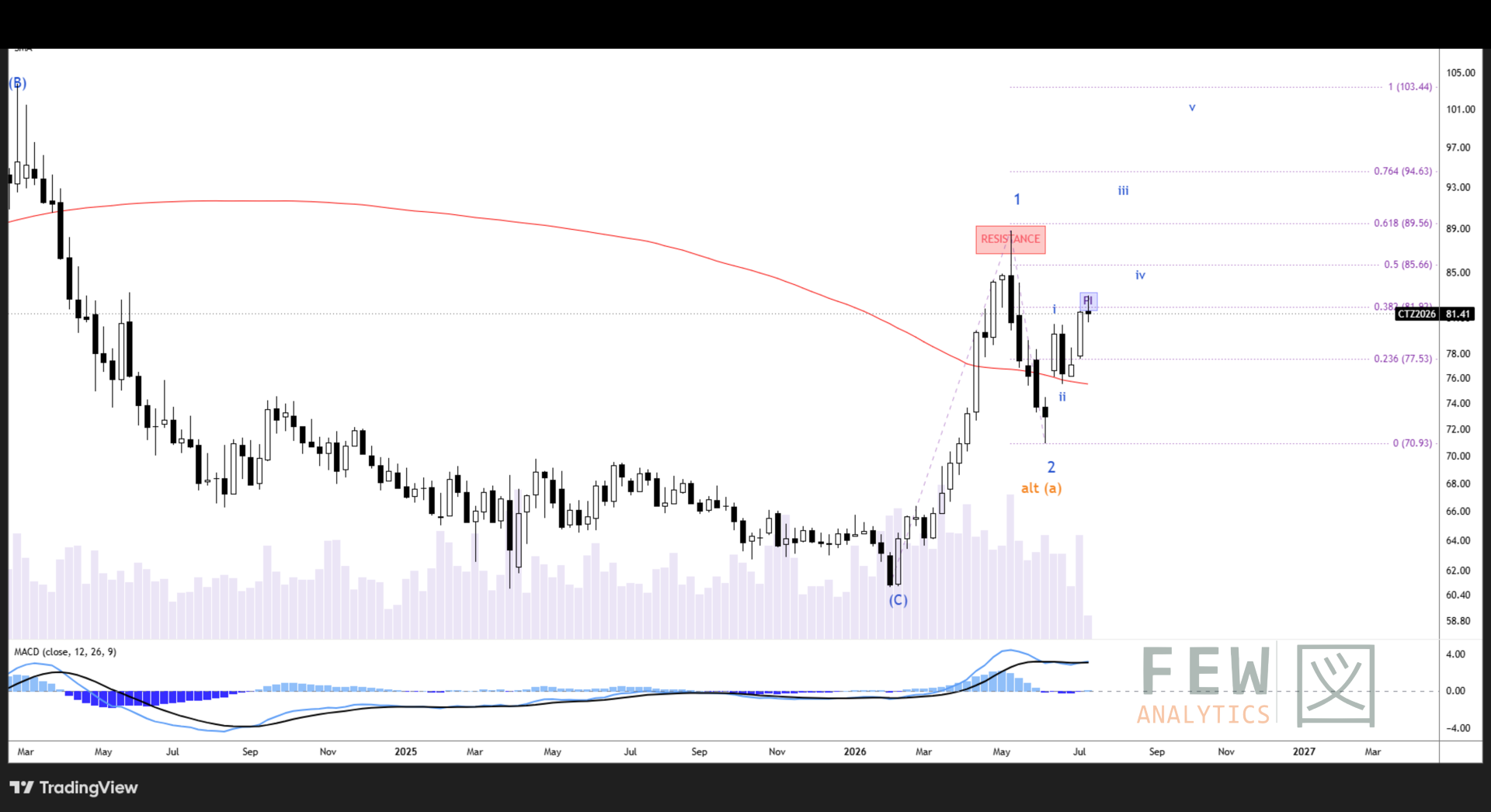
The long-term CT chart remains consistent with a bullish outlook into 2027. We are still forming the foundation for a breakout above the May 2026 high of 88.88. Expect a little backing and filling in this region before we see a breakout higher. The view is invalidated below 75.50.
Tactical
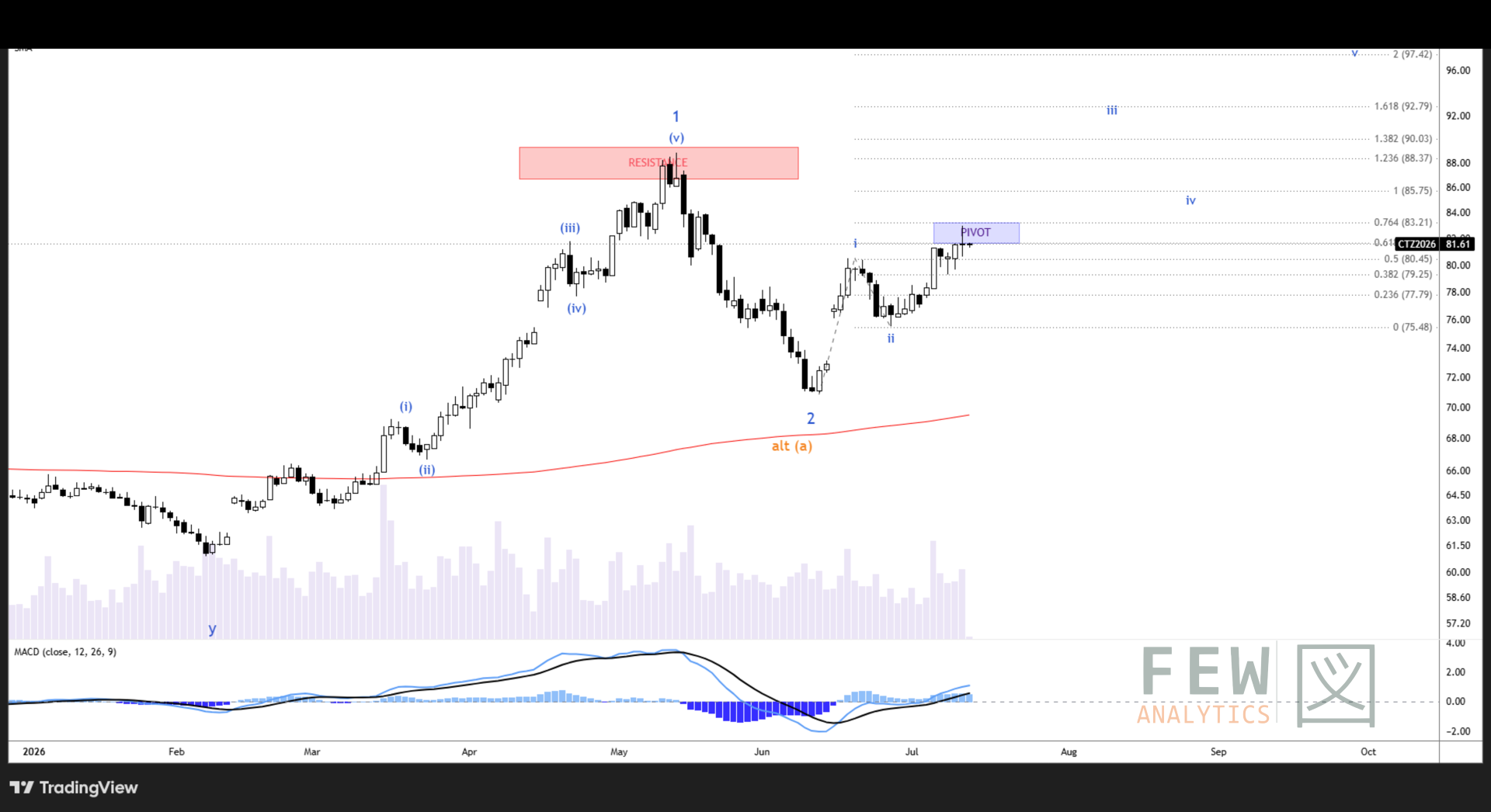
Over the week the market clarified CT’s short-term outlook somewhat, completing a micro five-wave move up off the 75.50 low. We are therefore counting the wave ii bottom as complete at that 50% retracement, with wave iii now in progress. Price is contained by a Fibonacci pivot area (blue box), which should trigger corrective action for a day or two. Next, we expect cotton to push higher in wave iii to the 92 region.
Cotton Positioning
CFTC data for 7 July showed managed money accounts hold a net long of 39,106 contracts, an increase of 7,121 from 31,985 the prior week. This net position was made up of 66,556 longs, up by 5,777 contracts from 60,779, and 27,450 shorts, only a 1,344 reduction. The net position was primarily driven by additional longs, with some short covering as the price rallied towards the end of the week ending 7 July.
Commercials net position moved 12,528 contracts WoW, an increase in net short to 121,581 from 109,053. Driven by additional shorts of 16,090 contracts from 180,469, and an addition of longs from 71,416 to 74,978.
Open interest rose by 25,705 contracts to 454,315, an increase of 6.0%, sitting in the 97th percentile of its 20-year range meaning it has only been here 3% of the time. The five-year chart corroborates this: although open interest remains below the May 12 peak of 515,041, it is still elevated relative to most of the past five years.

Balance sheet
The July 10 WASDE is the latest official read, and it folded in the June 30 Acreage report. Bearish for new crop. 2025/26 supply and demand held: exports 12.20M bales, domestic use 1.55M, ending stocks 4.20M, stocks-to-use near 30.5%; the farm price slipped half a cent to 62.5c/lb. For 2026/27, USDA lifted production 400k to 13.70M and ending stocks 400k to 4.10M, holding exports at 12.30M and the 73.0c price. New-crop stocks-to-use jumps to 29.5% from 26.6%.
The lift was all acreage. Planted area went to 9.85M acres, harvested to 7.54M at a ten-year average abandonment rate, roughly 23.4%; yield rose 6 lb to 872, on more Southeast and Delta area and less Southwest. Texas planted came in at 5.425M (+2.0%), with Delta and Southeast gains: Georgia 1.000M, Mississippi 430k, Alabama 360k. West Texas dryness is still the swing factor, and it won't tighten the sheet unless abandonment or yield losses beat what's already baked in.
Global stays tighter than the U.S. line. 2026/27 world production 117.30M (+1.2M), under consumption at 122.00M, ending stocks 71.20M, the lowest since 2018/19. Brazil is the share problem: USDA raised its new-crop production this month and still has it exporting a record 15.00M, ~34.6% of trade, against the U.S. at 12.30M, ~28.4%.
Planting has progressed into squaring
Monday's Crop Progress (week ended July 12): squaring 60% nationally, up from 49%, a hair ahead of last year and the average, both 59%; Texas 50%, up from 39%, just under last year's 53%. Boll setting 22%, up from 14%, dead on last year and the average; Texas 22%, up from 15%

Condition Report
The national condition report slipped again. U.S. cotton was rated 44% good/excellent, down from 46% last week and below last year's 54%. The fair category rose to 40%, while poor/very poor held at 16%. The national crop is not collapsing, but the good/excellent share continues to fade at a point when the market is increasingly focused on July weather and early boll-setting conditions.
Texas remains the main concern. The Texas crop was rated 30% good/excellent, down from 36% last week, while fair rose to 46%. Poor/very poor edged up to 24%, from 23%, and the overall distribution still looks stressed. The deterioration this week is therefore less about a fresh jump in poor/very poor acreage and more about fewer acres holding in the good/excellent category. That gives the market a weather-risk story to monitor, but because the July WASDE folded in the June Acreage report's 9.85 million planted acres against 7.54 million harvested, with abandonment near 23.4%, the market will likely need evidence that losses are exceeding USDA's existing assumptions before materially tightening the new-crop balance sheet.

US Cotton Export & Sales
For the week ended July 2, current-crop upland net sales rebounded to 66,400 running bales, up 36% from the previous week but still 49% below the four-week average. Vietnam and India were nearly tied as the largest buyers at 23,500 RB and 23,400 RB, respectively, followed by Mexico at 10,400 RB, Bangladesh at 4,000 RB, and China at 3,300 RB. New-crop 2026/27 upland sales increased to 87,000 RB, led by Vietnam at 48,700 RB, Turkey at 30,800 RB, Japan and Indonesia at 2,400 RB each, and Ecuador at 1,600 RB.
Shipments improved modestly but remained below their recent pace. Upland exports rose to 230,100 RB, up 5% from the prior week but 14% below the four-week average. The leading destinations were Vietnam at 85,400 RB, Pakistan at 42,800 RB, Turkey at 23,900 RB, Bangladesh at 21,200 RB, and Mexico at 18,400 RB. Pima net sales recovered to 2,600 RB, although they remained 42% below the four-week average. New-crop Pima sales totaled 17,500 RB, all for India, while Pima exports fell to 10,600 RB, down 57% from the previous week and 38% below the four-week average.

On a 480-pound statistical-bale basis, all-cotton weekly current-crop sales totaled 71,100 bales, while shipments totaled 247,900 bales. Cumulative current-crop shipments reached 10.923 million bales, approximately 22,800 bales ahead of last year’s 10.900 million at the same point. Total current-crop commitments stand at 12.776 million bales, about 576,000 bales above USDA’s 12.20 million-bale 2025/26 export forecast, which was left unchanged in the July WASDE.

To reach USDA’s 12.20 million-bale export target, shipments need to average approximately 319,000 bales per week over the final four full reporting weeks of the crop year. This week’s 247,900-bale shipment pace was roughly 71,000 bales below that threshold, so the shipment cushion narrowed further. Current-crop commitments remain more than sufficient on paper, but the market still needs to see those commitments converted into physical shipments. New-crop all-cotton sales totaled 107,600 bales for the week, lifting cumulative 2026/27 commitments to 2.677 million bales.

Texas soil moisture deteriorated again in the latest NASS data. Texas topsoil rated short or very short increased to 57%, up from 51% the previous week, while subsoil rated short or very short rose to 53%, up from 50%. Nationally, topsoil short or very short increased to 33%, up from 31%, while subsoil short or very short edged up to 36% from 35%. Texas cotton rated good or excellent fell to 30%, down from 36%, while the share rated poor or very poor increased to 24%.

The latest released U.S. Drought Monitor data are somewhat less negative. Data valid July 7 show 30.9% of Texas in D1-D4 drought, down from 32.2% in the previous report. Severe drought or worse, D2-D4, covered 11.3%, down from 12.8%. The improvement in mapped drought is helpful, but it contrasts with the continued deterioration in NASS soil-moisture readings and Texas cotton condition ratings.

CPC’s latest 6-10 day outlook, covering July 20-24, favors above-normal temperatures in North and South Texas and near-normal temperatures in West Texas. The state-level outlook calls for near-median precipitation across all three regions, although the accompanying discussion highlights increased odds of below-normal precipitation in parts of southeast Texas. Forecast confidence is 4 out of 5.
The 8-14 day outlook, covering July 22-28, favors above-normal temperatures across North, South and West Texas. Precipitation is expected to be near median in North and West Texas and below median in South Texas. Forecast confidence is 3 out of 5.
NHC currently reports that tropical cyclone formation is not expected during the next 7 days across the North Atlantic, Caribbean Sea, or Gulf.

Cotton On-Call
No major outlier in the latest Cotton On-Call report, other than the same issue as last week: An increase of 1,315 contracts in the unfixed call sales and still heavy concentration in the unfixed call purchases with 45,250 contracts in the new-crop December 2026 contract.

Outlook for Cotton
Bull Case
Texas stress worsened: good/excellent fell to 30%, with topsoil short/very short at 57%.
Commitments remain strong: 12.776m bales, about 576k above USDA’s export target.
Rain outlook is mixed: missed West Texas showers would keep abandonment risk elevated.
Bear Case
USDA raised supply: U.S. production increased to 13.7m bales and ending stocks to 4.1m.
Rain remains the key cap: verified High Plains coverage would quickly reduce the weather premium.
Demand is still soft: sales improved, but remain below recent averages; on-call positioning is not clearly bullish.
Base Case
Crop progress: U.S. 60% squared / 22% setting bolls; Texas 50% / 22%.
December near 80.9c: support 80.0/79.3c; resistance 81.5/83.0c.
Bias: neutral-to-firm. Constructive above 79.3–80.0c; bullish above 83c; bearish if rain verifies and December breaks 79.3c.
Coffee
Coffee Price Action
Arabica rallied over the week ending Tuesday 14 July, price spiked to 352.4 intraday before closing 326.1, week change of +8.50 cents (+2.7%). The market has softened relative to the prior week’s historic moves, however the market remains volatile. September Arabica settled at 326.10, December at 308, leaving the U/Z spread at +18.1 c/lb, out from +12.6 c/lb the prior week. July settled at 337.20 with open interest down to 466 lots from 592, leaving the N/U spread at +11.1 c/lb.
Robusta rallied mid-week, with September reaching 4,066 intraday on July 9 before reverting to settle the week at 3,849, a change of -23 (-0.6%) from the 7 July settle of 3,872. Prices remain well above the early-July lows near 3,714. September settled 3,849 and November at 3,800, leaving the U/X spread +$49/t, which has widened WoW by $16/t from $33/t. The forward curve remains in steady backwardation, with the terminal month at 3,628.
ICE arabica stocks fell again to 342,574 bags, a fresh 2.25-year low, while robusta certified stocks hovered around 684,000 bags. Margins for arabica increased again, on Jul 9 from 19,117.5 to 21,116.25. Exchanges increasing margins tends to lead to more bearish outlooks.
Technical Analysis
Strategic
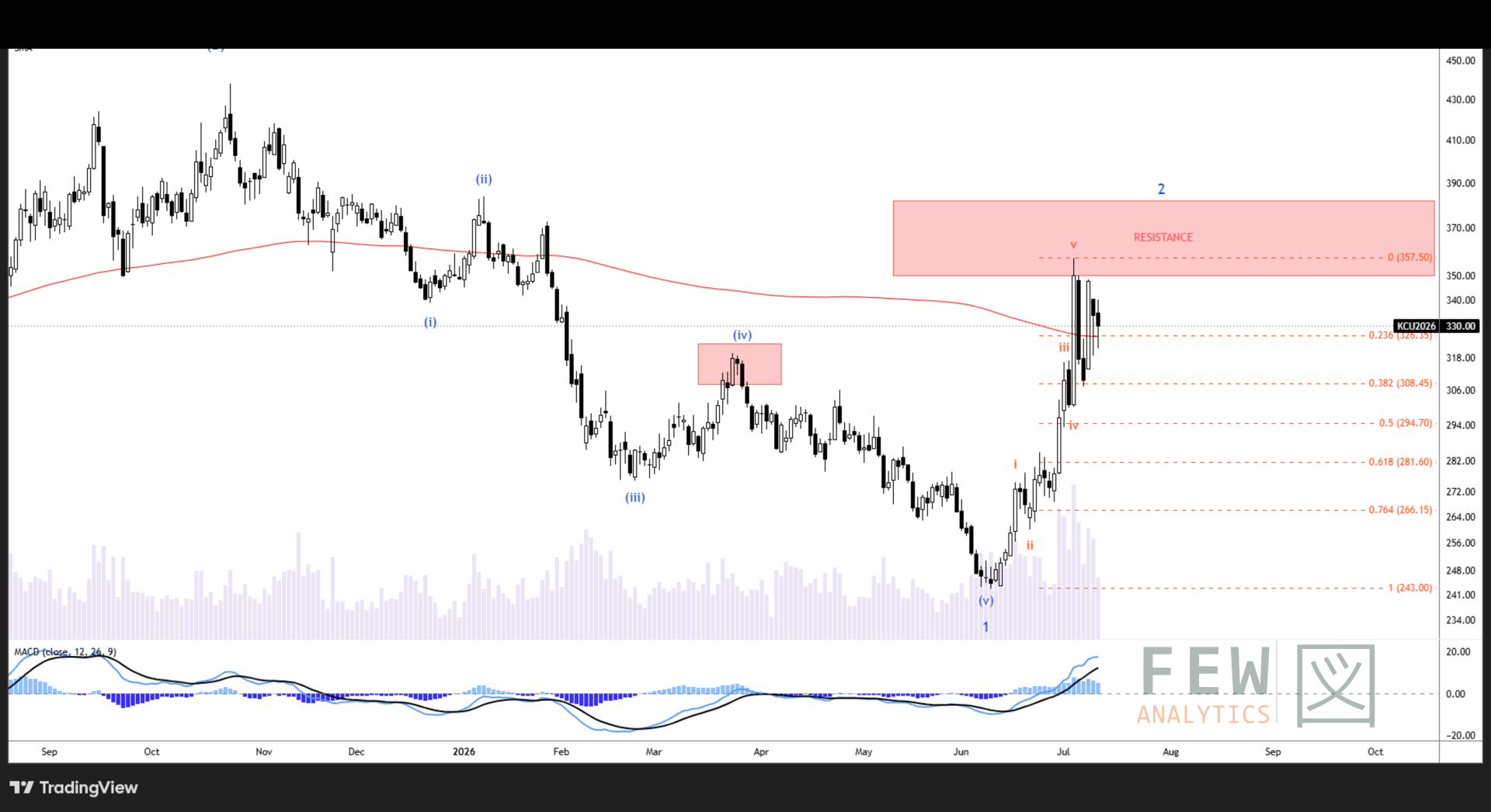
This week we call out where we stand in the big picture. The large spike discussed last week remains contained below the 350–380 resistance area, and so the bearish base case is retained until that resistance is breached. The projected decline is annotated in blue per standard Fibonacci targets; on the chart it does appear extreme. Accordingly, the bullish alternate count in orange remains entirely plausible. This sees the market as completing an ABC expanded flat correction, with higher to come. We will need to watch how the market resolves within this region before high conviction is available in the longer-term coffee outlook.
Tactical
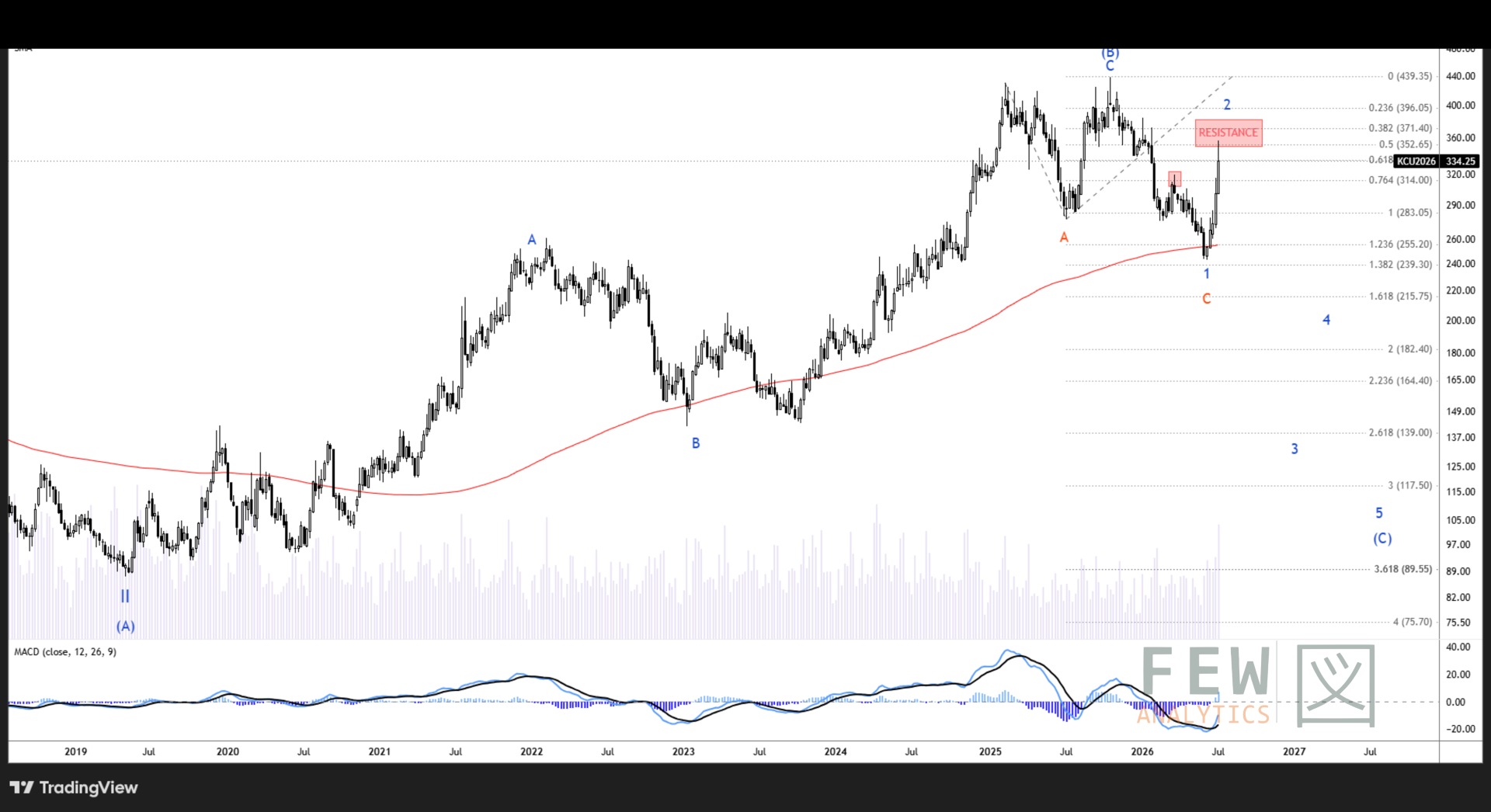
The daily chart illustrates why caution remains warranted in this region. The move up off the June lows counts well as a five-wave impulse, denoted in orange. Subsequent price action could also be considered overlapping, which is consistent with corrective wave structure. Bears need KC to break below 280 to consider taking the alternate bullish case off the chart. This leaves us in no man’s land until the market provides further clues.
Physical Pricing
Brazil differentials:
NY 2 17/18 Fine Cup differentials for September and December now stand at 9 over Sept-26 and 12 over Dec-26, respectively.
Additionally:
NY 2/3 14/16 - Fine Cup stands at 9 under Sept-26 and 6 under Dec-26,
NY 2/3 15/16 - Fine Cup stands at 7 under Sept-26 and 4 under Dec-26,
Moka - (9/10/11) - Fine Cup stands at 12 under Sept-26 and 9 under Dec-26.

Certified stocks: Arabica at 342,574 bags as it continues to drop ~243,047 bags in the last 4 months, a 41.5% decrease, while Robusta remains steady currently around ~684k bags


Coffee Positioning
Arabica’s fund position continues to build, with managed money net long 25,511, up 4,288 from 21,223 the prior week. Longs fell 337 to 40,054 and shorts fell 4,625 to 14,543. The move was driven primarily by short covering, a response to the price rally during the week of the 6th, which saw September contract’s open interest fall by 3,038 on Tuesday the 7th.
Commercial accounts held a net short position of 25,432 contracts, with 43,510 longs and 68,942 shorts. The net short deepened by 5,408 from the previous week’s 20,024, driven by long liquidation (-5,653), with some short covering (-245), as commercials continue to build their net short position.
Robusta open interest rose 12,709 to 125,723 contracts. Commercials deepened their net short by 7,622 contracts to 48,627, primarily from fresh shorts added (+5,981) alongside long liquidation (-1,641). Managed money increased their net long position by 5,607 to 44,195 contracts. This was a mix from short covering (988 contracts) and additional longs (4,619 contracts).


Outlook
Bull Case
ICE arabica stocks fell to 342,574 bags, a 2.25-year low; Sep/Dec backwardation widened to roughly +18.1c/lb.
Brazil’s harvest is only 52% complete versus 60% last year, with rain delays and cherry drop threatening prompt quality and availability
El Niño risk around Sep–Oct flowering keeps a retest of 350–357c in play.
Bear Case
Sep settled at 326.10c, down 1.18% Tuesday and 30.9c below the 357c spike; two ICE margin hikes and thin liquidity favour sharp reversals.
Brazil’s record crop remains the ceiling: USDA 71.9m bags; private estimates 75.4–75.8m bags.
Robusta is weak confirmation: stocks recovered to 4,220 lots, Vietnam H1 exports rose 7.3% to 1.05 MMT, and funds hold 44,195 net-long contracts.
Base Case
Tight nearby, looser forward—but now a high-volatility range rather than a clean breakout.
Sep near 326c: support 320–315c, then 310–300c; resistance 340–352c, then 357c.
Bias: fade rallies into 340–350c, but avoid chasing shorts below 315c while stocks remain under 350k bags and U/Z holds near +18c.


