

Summary
Key Takeaways:
Texas weather continues to support cotton prices, although ample U.S. stocks are limiting further gains.
Tight ICE arabica stocks are underpinning coffee prices, despite expectations of a large Brazilian crop.
Sugar remains under pressure, with record speculative short positions increasing the risk of a sharp rebound.
Central banks held interest rates steady as markets continue to assess the outlook for inflation and policy.
Oil prices retreated after geopolitical tensions eased, reducing near-term inflation concerns.
Markets are now focused on the August USDA report, Texas weather, and Brazil's election as key drivers ahead.
Cotton
Cotton remains a weather-driven market, and conditions in Texas deteriorated further this week without producing a decisive breakout. U.S. squaring reached 88% and boll setting 55%, both near average. National good/excellent fell to 42% from 46%, and poor/very poor rose to 20%.
Texas remains the key risk: good/excellent dropped to 28% from 34%, while poor/very poor rose to 30% from 24%. December cotton settled at 82.46 c/lb on 4 Aug.
USDA’s balance sheet continues to limit the upside, with U.S. production projected at 13.7m bales and ending stocks at 4.1m bales, or 29.5% of use. Export demand has slowed down, current-crop upland sales fell 42% to a MY low of 29,700 RB, though new-crop reached 352,400 RB.
Coffee
Brazil’s harvest reached 64%, still behind 77% last year and the five-year average of 70%. September arabica settled at 323.05c/lb, while robusta closed at US$3,854/t.
Large crop estimates remain bearish: 66.7m–75.4m bags. However, ICE arabica stocks have fallen to around 260,720 bags, keeping squeeze risk elevated. Robusta certs are are steady near 700k bags versus 1.18m a year ago.
Global Macro
Interest rates: The Fed left rates unchanged at a range of 3.5-3.75% (9-3 vote), short-term yields fell and the markets are now pricing in a roughly 63% probability of a rate hike in September. BoE held rates at 3.75% with a vote of 6-3 (three in favour of raising rates), and the bank’s projection showed CPI inflation peaking at around 3.2% in 2026 Q4 (CPI inflation was 2.6% in June). BoJ rates remained unchanged at 1.0%.
World snapshot: Trump called off planned strikes on Iran over the weekend. Brent dropped 7.4% to settle around $83.8/bbl on Mon the 3rd, off the back of Trump pulling out, having traded as low as $81.5/bbl intraday. Gold steadied around $4,038 an ounce on Mon the 3rd, and the US benchmark 10yr Treasury yield rose fractionally to 4.68%, as investors continue to evaluate the US monetary policy.
Brazilian election is around the corner with campaigns commencing 16 Aug and first elections Oct 4. It is the battle of the ages…sorry, of policy platforms. The differentiating data, rigorously sourced: Lula is 80, Flávio is 45. On the actual numbers, Polymarket heavily favours Lula at 65% vs 27%. Concerns for Brazilian Petrobras fuel-pricing policy.


Cotton
Cotton Price Action
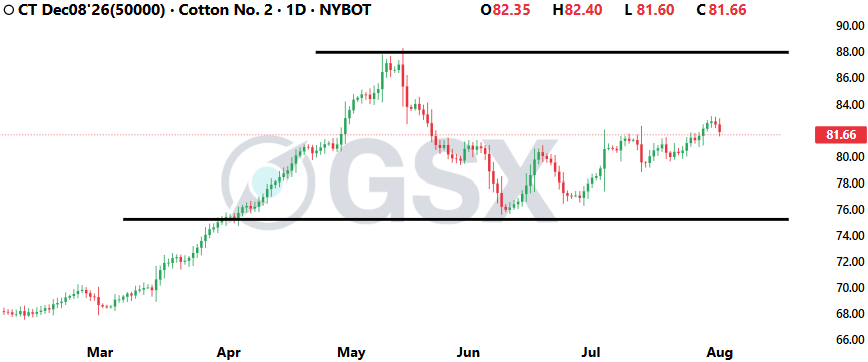
ICE Cotton has established a new trading range of 75 - 88 c/lb over the past three months, off the back of its February low of around 67 c/lb. CT has traded in swings of 400 points during June and July, before retracing to a range 78 - 83 c/lb in the last 30 days. The five-year range is 59.06 - 153.76 c/lb, which positions current price toward the lower end. It is around 72 cents below the five-year high and 23 cents above the low.
Click to Zoom
Dec 26 settled 82.46 c/lb, Oct 26 settled 81.13 c/lb, Mar 27 settled 84.05 c/lb, and May 27 at 85.19 c/lb. Against the 4 Aug closes that leaves Dec down 11 points and Mar down 8 points.
Next event is the next release of the Aug WASDE on the 12th. The July WASDE was mildly bearish, raising 2026/27 production to 13.70 million bales and ending stocks to 4.10 million, a 29.5% stocks-to-use ratio.
The seven-market spot average rose 31 points to 73.70 c/lb for the week ending 30 July. Transactions reported 817 bales, which is in comparison to 3,785 bales the same time a year ago. Marketing year 2025/26 total spot transactions were 1,525,746 bales compared to 995,781 at the end of 2024/25. Crop ratings eased to 42% good/excellent from 46%, with 88% squaring and 55% setting bolls. Record heat across West Texas is the bullish lever, and certified stocks fell to 90,699 bales.
Technical Analysis
Strategic
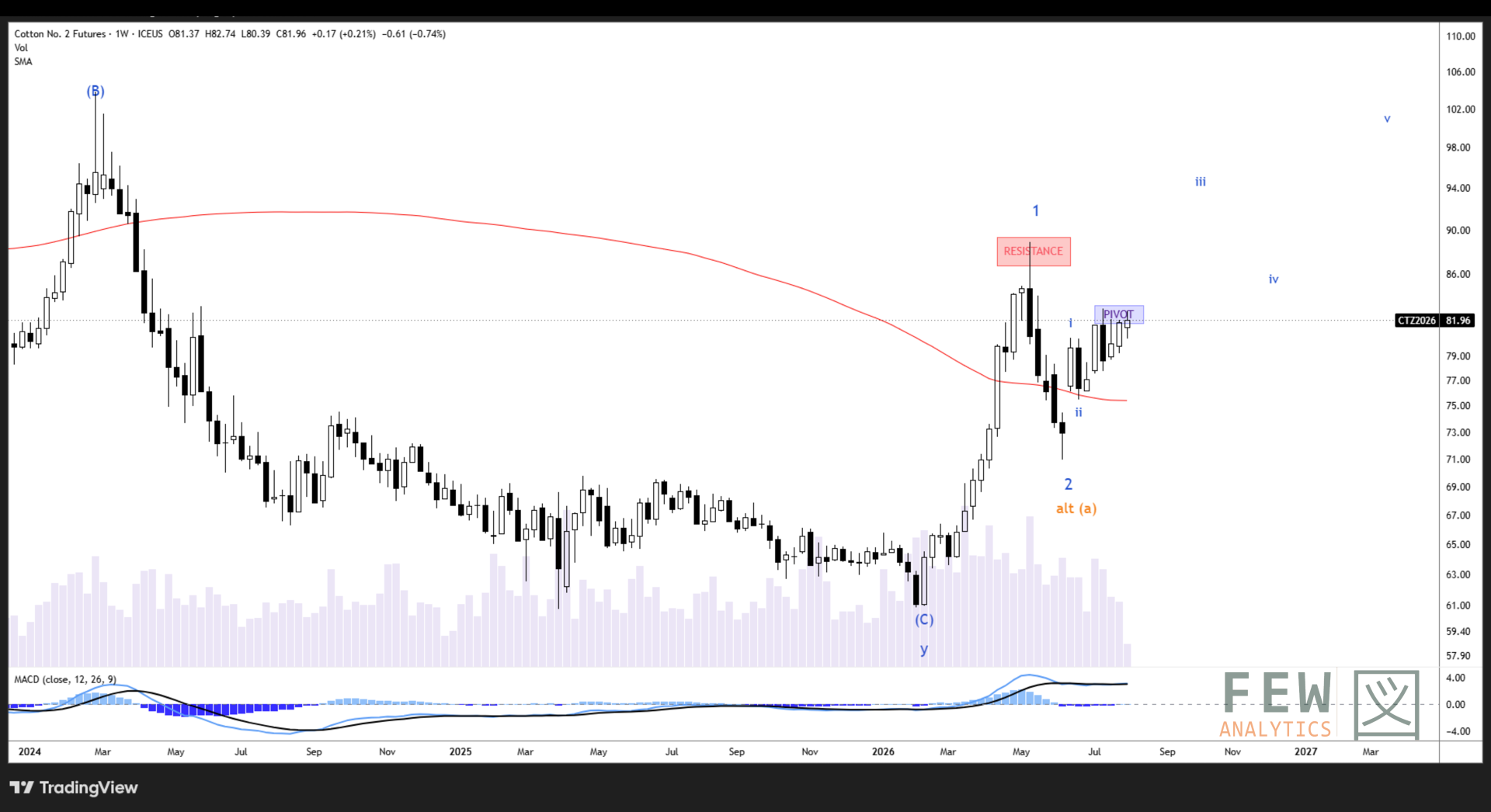
Cotton is doing what we asked of it. The weekly upward trend holds and price continues pushing against the 81.50–83 Fibonacci extension pivot box, sitting just under the ceiling. A close through 83 opens the path to a new 2026 high, with 100 a very reasonable target.
Click to Zoom
Tactical
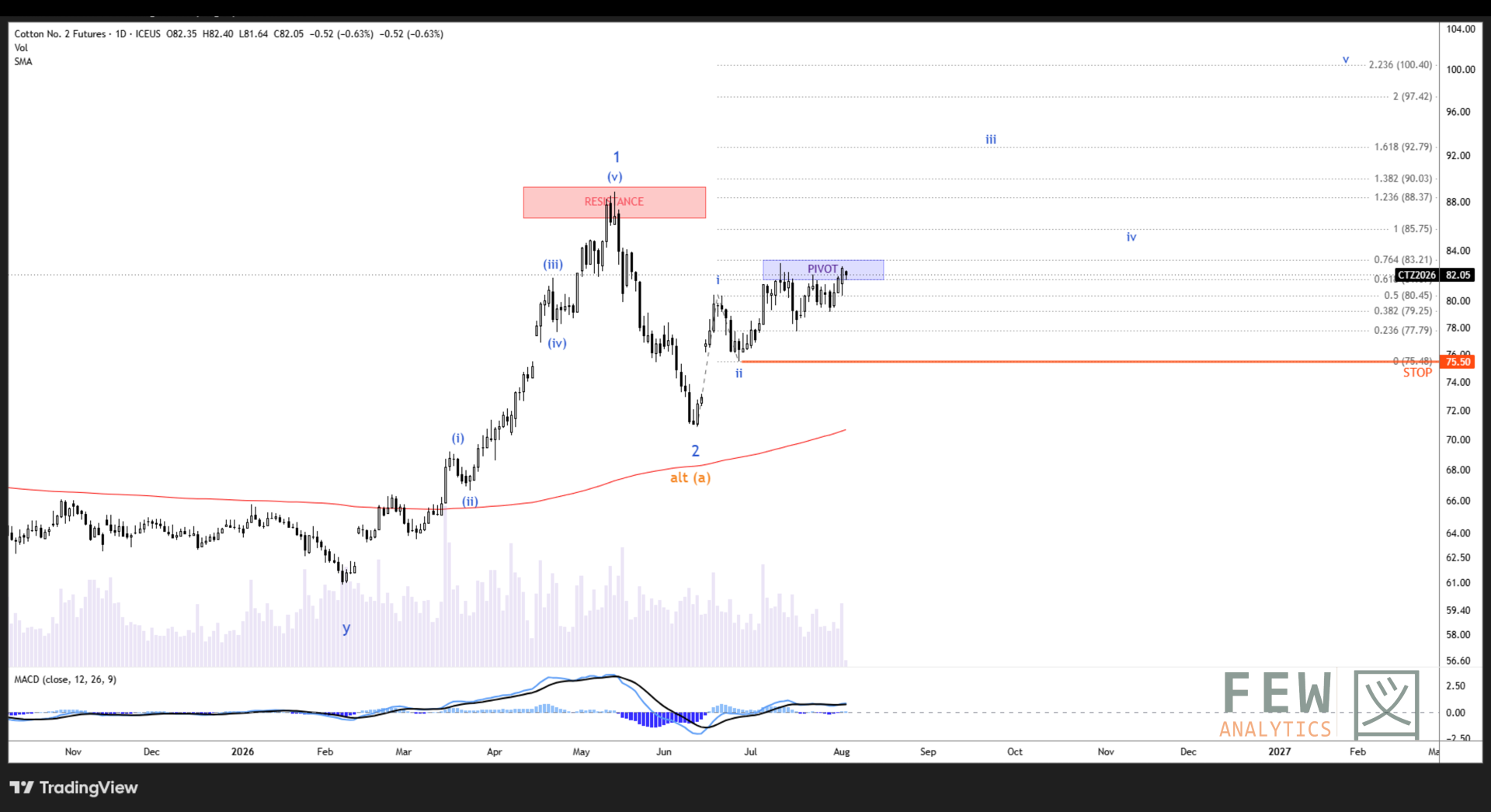
CT futures have been suppressed by our pivot box for more than three weeks straight now. The move up off the mid-July lows is a little amorphous, however printing higher highs in keeping with our bullish
base case. Breaking above 83 puts cotton in the heart of wave iii up, 92 the interim objective and 100 the ultimate target. A drop through 75.50 invalidates this view.
Click to Zoom
Cotton Positioning
CFTC data for 28 July showed managed money accounts net long position fell by 799 contracts to 52,410. Long position fell by 805 contracts to 74,182 - on the back of a midweek price rally reaching 82 c/lb - and their short position also fell by 6 contracts. Managed money long position is at the 86th percentile while shorts are at the 57th percentile, leaving less room for additional longs as the position remains crowded.
Other Reportable net long position fell by 1,107 contracts, primarily driven by long liquidation (1,868), partially offset by short covering (761). Other Reportable net long position sits at the 99th percentile, territory it has only been in 1% of the time, which is prone to liquidation from a declining price shock.
Open interest rose by 7,190 contracts to 455,225, sitting in the 97th percentile of its 20-year range, a level exceeded only 3% of the time.


Balance sheet
The 10 July WASDE remains the latest official read. For 2025/26, exports remain 12.20m bales, ending stocks 4.20m and the farm price 62.5c/lb. For 2026/27, production is 13.70m, ending stocks 4.10m, stocks-to-use 29.5% and the price forecast 73.0c/lb. The key assumptions remain 7.54m harvested acres and 872 lb/acre; Texas must underperform those assumptions to tighten the U.S. sheet.
Globally, production of 117.26m bales remains 4.69m below consumption of 121.95m, with ending stocks at 71.22m. The world balance is supportive, but the U.S. balance remains burdensome. The next major production update is 12 August.
Planting has progressed into squaring
Squaring reached 88% nationally, up from 81% and just above the five-year average. Texas reached 82%, up from 74%, but remains a point behind average.
Boll setting advanced to 55% nationally and 46% in Texas, both only one point behind their five-year averages. Development remains broadly on schedule.

Condition Report
Crop ratings worsened. U.S. cotton fell to 42% good/excellent, from 46%, while poor/very poor rose to 20%, from 16%.
Texas recorded the lower levels: good/excellent decreased to 28%, from 34%, while poor/very poor rose to 30%, from 24%. This partially reverses last week’s deterioration, although Texas conditions remain weak enough to keep yield risk alive.

US Cotton Export & Sales
For the week ended 30 July, current-crop upland sales dropped 42% to 29,700 RB marking a marketing-year low, while new-crop sales reached a remarkable 352,400 RB for the new 2026-27 marketing year. Upland shipments fell 15% to 233,800 RB. On a 480-lb statistical-bale basis, all-cotton shipments were approximately 245,400 bales, lifting cumulative exports to 11.691m.

Total commitments increased to 12.905m bales, 705,000 above USDA’s 12.20m export forecast, but the shipment target is now out of reach. With 509,000 bales still to ship and only one week to 30 July, exports look set to finish near 11.94m, roughly 260,000 short of forecast.

At the current pace, approximately 0.97m bales of unshipped old-crop sales are likely to roll into 2026/27. Combined with 3.070m already booked for new crop, opening commitments would be near 4.04m bales, or 33% of USDA’s 12.30m forecast. Our base case is a 250,000-bale August WASDE export cut to 11.95m, lifting new-crop beginning stocks to 4.45m and ending stocks to 4.35m. The adjustment is mildly bearish, although the August production revision remains the larger balance-sheet risk.

Soil moisture deteriorated alongside the ratings. Texas topsoil rated short or very short increased to 71%, from 60%, while subsoil short or very short rose to 60%, from 51%.
National topsoil short or very short increased to 48%, from 47%, while subsoil rose to 52%, from 48%. This is the week’s clearest supportive weather signal and limits the comfort from better condition ratings.

The latest Drought Monitor remained constructive for Texas. D1–D4 drought increased to 23.2%, from 22.1%, and D2–D4 also increased to 9.5%, from 8.7%.
The broad drought picture continues to deteriorate, but the map is valid through 28 July and therefore predates some of the deterioration captured in the latest soil-moisture report.

For 10-14 August, CPC favors 40-60% probability above-normal temperatures across all Texas regions. Precipitation is near median in North and West Texas and below median in South-East Texas.
For 12-18 August, above-normal temperatures remain favored statewide, but precipitation is near median across North, South and West Texas. The heat risk remains, but the explicit dry signal has eased.

Cotton On-Call
No major outlier in the latest Cotton On-Call report: An increase of 161 contracts in the unfixed call sales and still heavy concentration in the unfixed call purchases with 41,784 contracts in the new-crop December 2026 contract.

Outlook for Cotton
Bull Case
Texas stress: good/excellent deteriorated to 28%, with topsoil short/very short at 71%.
Commitments remain strong: 12.905m bales, about 705k above USDA’s export target.
Rain outlook is mixed: missed West Texas showers would keep abandonment risk elevated.
Bear Case
USDA raised supply: U.S. production increased to 13.7m bales and ending stocks to 4.1m.
Rain remains the key cap: verified High Plains coverage would quickly reduce the weather premium.
Demand is still soft: sales fell, and remain below recent averages; on-call positioning is not clearly bullish.
Base Case
Crop progress: U.S. 88% squared / 55% setting bolls; Texas 82% / 46%.
December near 82.46c: support 80.0/79.3c; resistance 81.5/83.0c.
Bias: neutral-to-firm. Constructive above 79.3–80.0c; bullish above 83c; bearish if rain verifies and December breaks 79.3c.
Coffee
Coffee Price Action
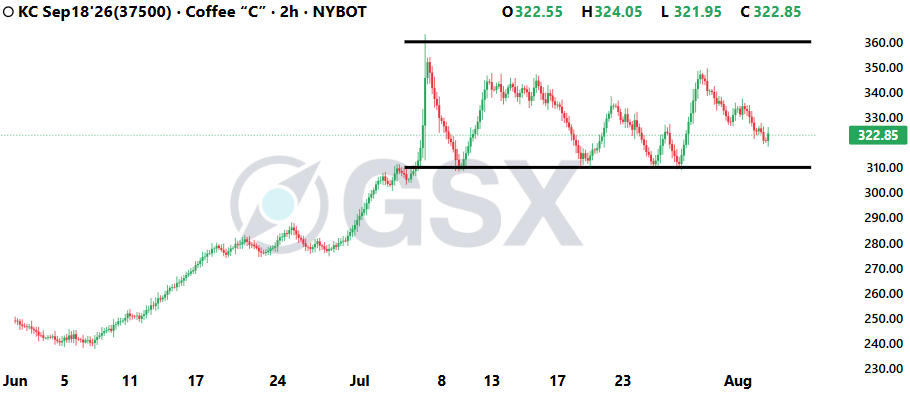
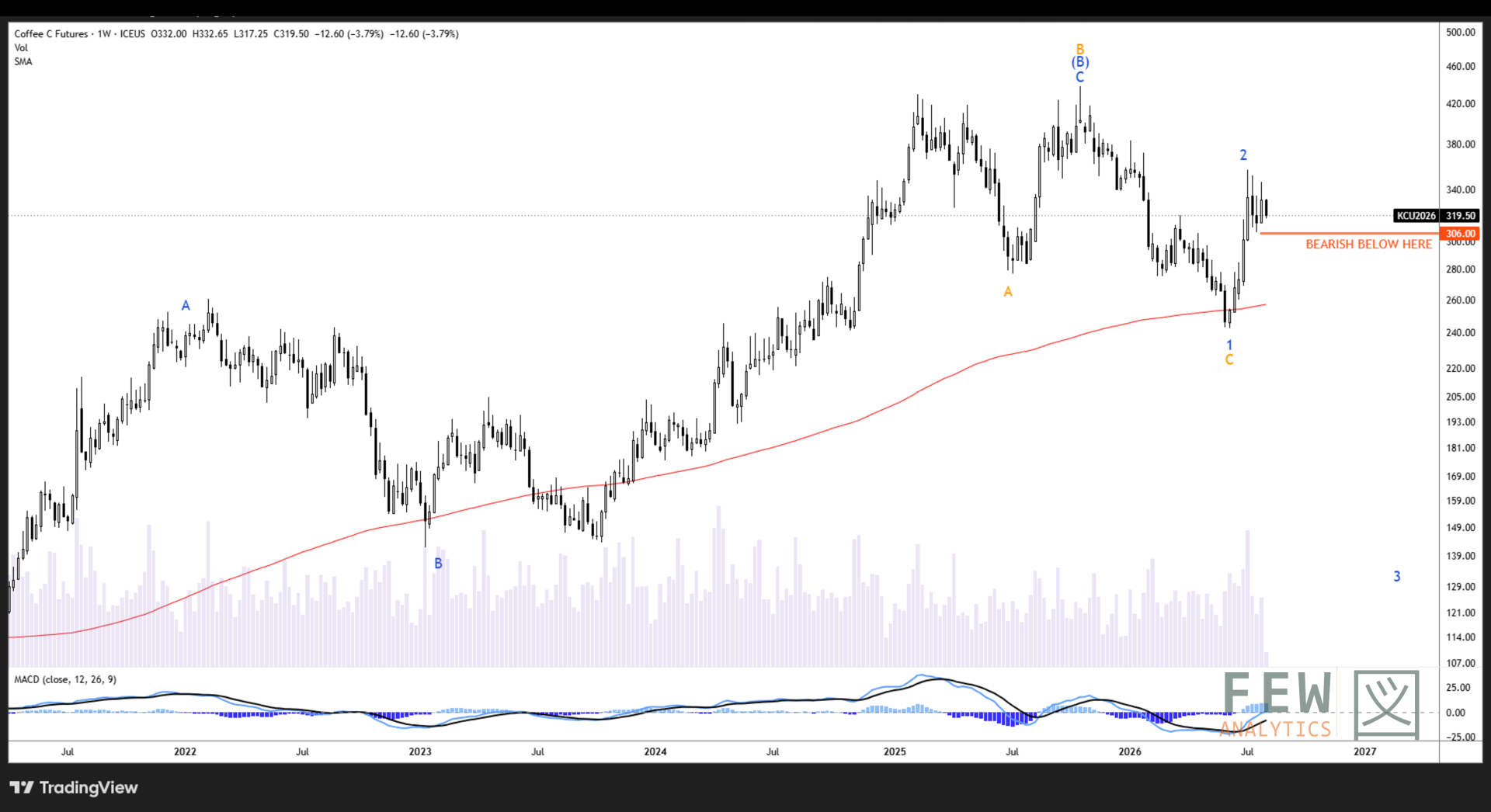
KC continues to trade off technical levels and has been driven fundamentally by weather forcasts from Brazil and by export numbers from Cecafe in Brazil. The range the market has established is 310 to 360, the market needs a fundamental catalyst to be able to break above or below this range. ICE has reduced KC margins after the market rally a few weeks ago, a reduction from $21116.25 to $14606.25.
Click to Zoom
COT’s reporting corroborated the current market as managed money showed almost no change in length of Arabica’s futures, net rise of 270 to 25,136 contracts. The farmers have enjoyed the market rally into peak harvest, as they are in no hurry to sell aggressively until the market finds new highs. The Brazil weather forecast for the last week has played out in favour of the farmers as well, fueling more optisimism in regard to the progress of the harvest.

Arabica Sep 26 settled on Tuesday, 4 Aug 323.05, Dec 26 at 308.8, leaving the U/Z spread at +14.25 c/lb, fell from +22.1 c/lb the prior week. Sep and Dec are the most active with Sep open interest at 51,366 and Dec at 65,244 lots.
Robusta has similarly held a range of 3700 - 4100 $/t, since its low in May. Cert stocks remain historically tight at 700k bags, down from 1.18m a year ago, but have turned up 15% off their early-June low. Managed money has length in the Robusta futures, as it represents 33% of the total open interest.
Technical Analysis
Strategic
KC has spent another week inside the same 300–350 band, so the strategic view sits where it did last week. The chopsolidation carries on. A wave iii down should have produced impulsive downside by
now, and it hasn't, which keeps eroding the odds on the bearish base case. A lot rides on the short-term moves to dictate where we go long term at the moment. So retaining the same base case until that changes. More detail in tactical notes.
Click to Zoom
Tactical
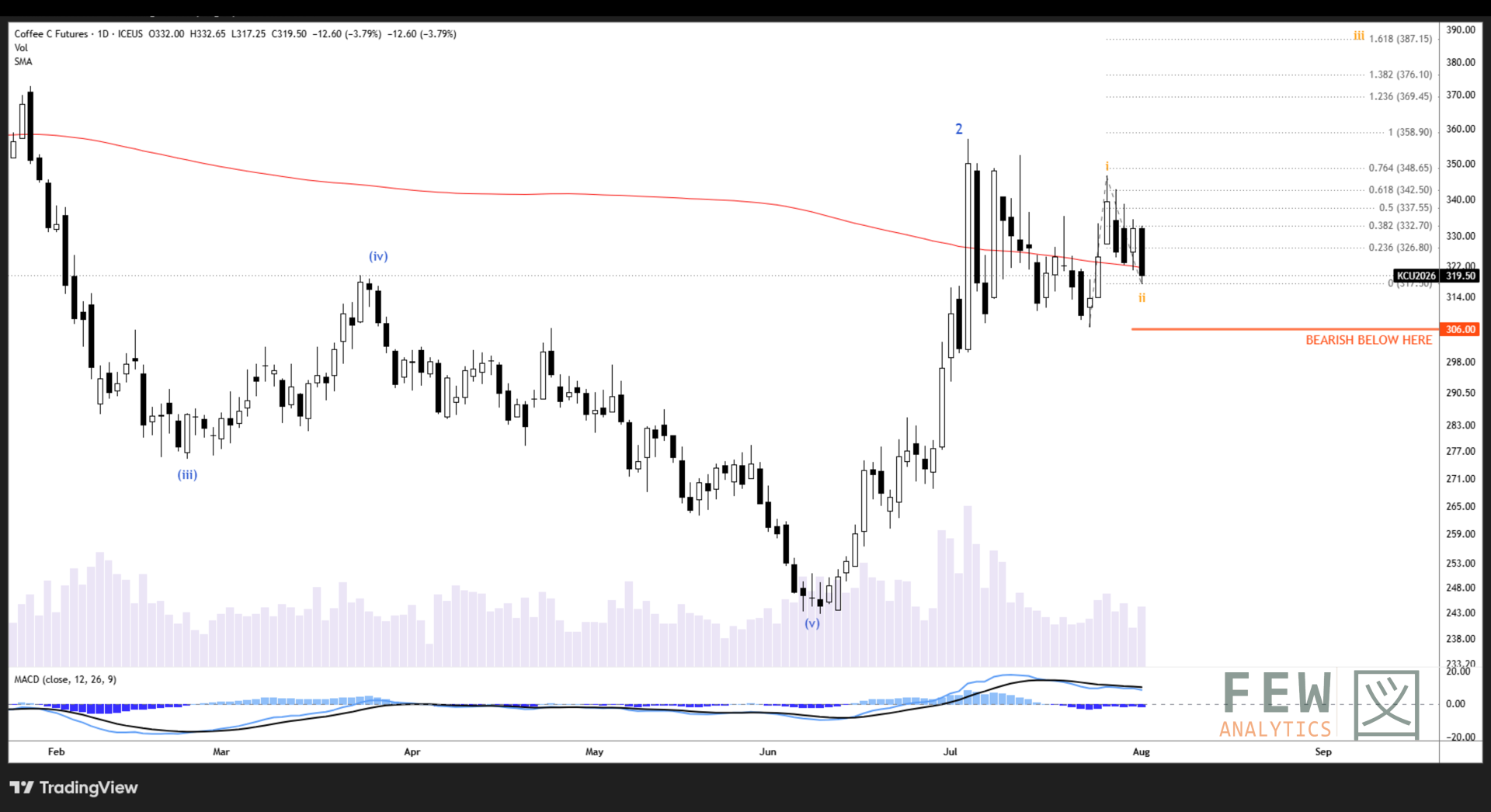
Last week KC gave us a nascent impulsive upswing off the 24 July low. We were looking for a pullback to hold 306, and since then the market has delivered just that. This recent action makes tactics quite simple. If KC breaks above the recent 347 high, bullish scenario targeting new 2026 highs is in play. However, a break of 306 confirms us firmly in the bearish base case.
Click to Zoom
Physical Pricing


Certified stocks: Arabica at 260,720 bags as it continues to drop ~285,398 bags in the last 4 months, a 52.26% decrease, while Robusta remains steady currently around ~700k bags
Stock stored is heavily skewed in Antwerp, reduced WoW distribution from 199,485 to 176,703 bags (11.42% decrease).


Coffee Positioning
CFTC report for 28 July showed Arabica’s managed money net long position rise by 270 to 25,136 contracts. Driven by short covering of 829 contracts, partially offset by long liquidation of 559 contracts - as the price moves within a range of 310-350 c/lb, and no clear direction.
Robusta’s managed money net long position fell by 2,855 contracts to 39,559. Primarily from long liquidation of 2,376 contracts and additional shorts of 479 contracts. Managed money long position is crowded at the 95th percentile, and its net long position sits at the 96th percentile. This leaves little room for additional long positions and is prone to liquidation if price were to drop on a fundamental shock.
Robusta commercials net short position fell by 2,915 to 43,070, driven by additional longs (1,296), with some short covering (1,619). Net short position at the 4th percentile provides a cushion for managed money liquidation.


Outlook for Coffee
Bull Case
ICE arabica stocks fell to 260,720 bags, a 2.25-year low; Sep/Dec backwardation tightened to +14.25 c/lb.
Brazil’s harvest is only 64% complete versus 77% last year, with rain delays and cherry drop threatening prompt quality and availability.
Bear Case
Sep settled at 323.05c, down 1.44% Tuesday and 33.95c below the 357c spike; two ICE margin hikes which have been reverted, however thin liquidity favours sharp reversals.
Brazil’s record crop remains the ceiling: USDA 71.9m bags; private estimates 66.7–75.4m bags.
Robusta is weak confirmation: stocks recovered to 4,237 lots, Vietnam H1 exports rose 7.3% to 1.05 MMT, and funds hold 39,559 net-long contracts.
Base Case
Tight nearby, looser forward—but now a high-volatility range rather than a clean breakout.
Sep near 323.05c: support 320–315c, then 310–300c; resistance 340–352c, then 357c.
Bias: fade rallies into 340–350c, but avoid chasing shorts below 315c while stocks remain under 300k bags and U/Z holds near +15.3c.
Sugar
Sugar Price Action
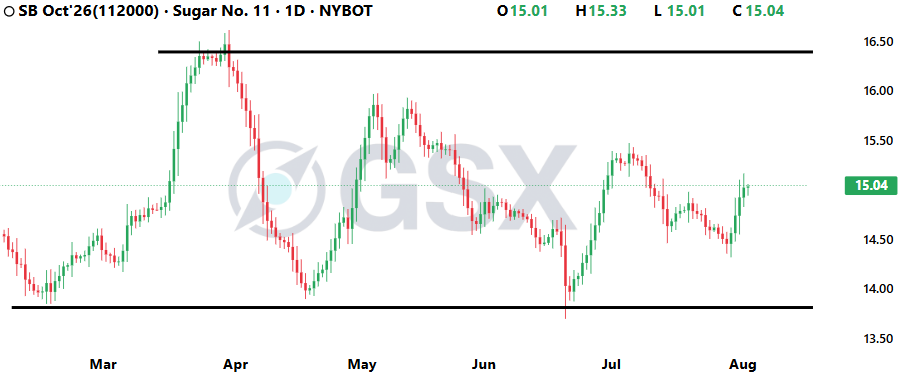
No.11 trades near the lower end of its five-year 13.36 - 27.97 c/lb range, with Oct ‘26 settled 15.04 on Tue 4 Aug - 12.93 cents below five-year continuous high. It has established a low of 13.8 c/lb over the past 6 months, with each rally failing lower. The highs have compressed while the floor has held, leaving the price in the 13.8 - 16.40 c/lb range.
Click to Zoom
At Tuesday’s settlement, Oct ’26 settled at 15.04 c/lb, up 0.03 cents, while Mar ’27 settled at 15.98 c/lb, up 0.07 cents, leaving the V/H spread at 94 points of carry, which reflects comfortable near-term physical supply.
The market is waiting for a catalyst which is evident in last Friday’s COT. Funds are bearish with net short 112,413 contracts and a very crowded short position in No.11 futures of 294,222. Any genuine supply scare and that short base becomes the fuel; stop losses triggered and the price move exacerbates what the fundamental news alone would justify.
Weather
The Indian Monsoon is the swing factor at the moment for No.11. Cumulative rainfall for June was significantly lower than historically, deficit of 40% (lowest June rainfall since 2014 - 99.5 mm). Rainfall has since rebounded and July recorded a surplus of 1% above normal, however the cumulative monsoon season remains a deficit of 11.8% through till 4 Aug. The core cane belt has not been hit as hard as the rest of India, and the export ban remains in place until Sept 30.


Sugar Positioning
CFTC data for 28 July showed the managed money long position fall by 2,685 to 181,809, and the short position rose by 13,132 to 294,222, at the 96th percentile. The net short position rose by 15,817 to 112,413 which is at the 9th percentile and leaves the short book close to as crowded as it has been in 20 years.
Other Reportable net long position fell by 18,366 to 30,734, primarily from additional shorts (16,844), with some long liquidation (1,522).
Commercials and Swap dealer net both sit in the 75-100 percentile. Commercials net short fell by 23,259 to 115,097 for a third week in a row, driven by both additional longs (7,813) and short covering (15,446). Swap dealer net long rose by 11,846 to 191,553, from additional longs (8,781) and short covering (3,065).
Interestingly, in one week specs sold 34,183 contracts and the commercials and swap dealer bought 35,105 contracts, which showed that the spec selling was almost entirely absorbed by commercials and swap dealer.
Open interest rose by 10,935 to 1,203,654 contracts, and also rose to the 89th percentile of its 20-year history, placing participation toward the upper end.


Sugar-Ethanol Parity
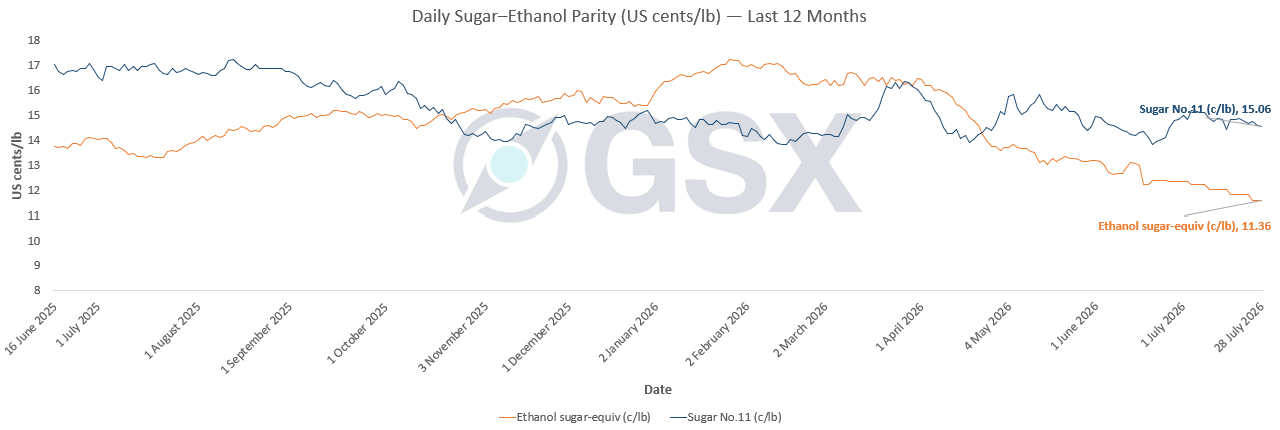
The daily parity model shows sugar favoured, at 15.06 c/lb against the equivalent sugar-ethanol price of 11.36 c/lb, the premium rose to 3.7 c/lb from 2.98 c/lb. Mills latest Hydrous ethanol price is 0.4015 US$/litre, a weekly change of -1.86%, as it continues to decline over the last month (month change of -8.38%).
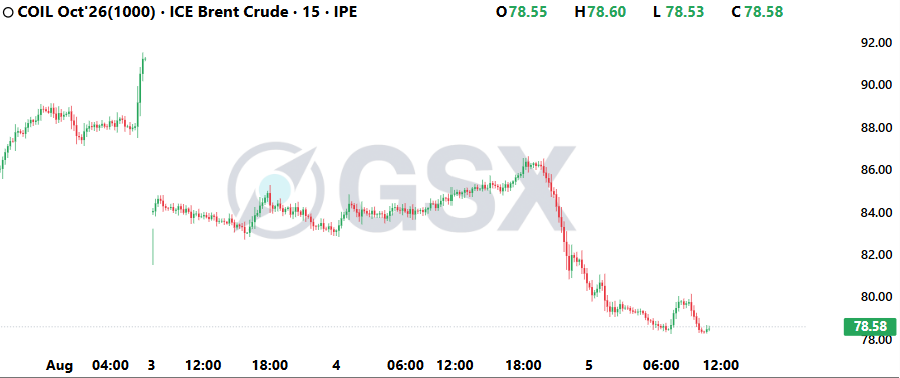
The swing factors that will determine the mix are domestic ethanol prices, sugar prices in USD, the FX rate of USD/BRL, Petrobras policies which are politically driven and then a delayed effect of Brent crude prices. Crude prices have been volatile off the back of Trump’s announcements. Mon 3rd market open saw crude drop from previous Friday’s spike of $90/bbl to around $81.5/bbl before closing $83.8/bbl - primarily driven by Trump calling off weekend strikes. Tue 4th recovered to around $86/bbl before an overnight selloff took the front month (Oct ‘26) to $79.6/bbl. If crude drops lower it is likely to see mills begin to divert to sugar, however price rallies will keep mills converting cane into ethanol.
Base case for mills to push more toward sugar would be that USD/BRL holds steady or rises, crude prices to remain or decline off the back of an easing US-Iran war, and finally for domestic CEPEA hydrous prices to carry on declining.
Click to Zoom
Click to Zoom


