

Summary
Key Takeaways:
Cotton remains a weather-driven market, with Texas conditions the key factor to watch.
USDA forecasts a tighter 2026/27 cotton balance sheet, but demand has not yet provided a strong bullish catalyst.
Brazil's large coffee crop continues to cap rallies, despite harvest delays and quality concerns.
Tight certified coffee stocks are supporting prices and increasing sensitivity to weather disruptions.
Higher interest rates and a firmer U.S. dollar remain headwinds for commodity markets.
Coffee retains greater near-term upside potential, while cotton needs a clearer weather-related trigger to move higher.
NEW TECHNICAL ANALYSIS OFFERING
We are pleased to introduce a dedicated Technical Analysis section to the GSX Weekly Research offering. Designed to complement our fundamental market commentary, this new addition provides deeper insight into market trends, key price levels, and potential trading scenarios, helping clients develop a more complete view of commodity market dynamics.If you want to understand the charts further, you can read about how to interpret them here.
Cotton remains a weather market, but the board still lacks a clear trigger. Planting reached 92% by June 21, versus the 94% five-year average, while squaring rose to 27%, ahead of normal. National conditions improved to 53% good/excellent, but poor/very poor also increased to 13%. Texas remains the key risk, with 90% planted, 44% good/excellent and 20% poor/very poor. December cotton is near 79.4c/lb and still needs a visible High Plains deterioration to break higher.
USDA’s 2026/27 balance sheet remains supportive, with consumption at 121.8m bales, production at 116.0m and ending stocks falling to 71.1m. Weekly U.S. exports were softer, with 177,100 RB sold and 251,000 RB shipped. Supportive overall, but not yet strong enough to drive a major move.
Brazil remains the coffee market’s record-crop anchor, with estimates of 71.9m to 75.65m bags. Harvest was only 39% complete, behind last year, while rain in Minas has increased flow and quality risk. September arabica rallied to about 276c/lb, with certified stocks near 393,000 bags in New York and 672,000 bags equivalent in London. The crop caps rallies, but tight stocks and weather risk are supporting prices.
Macro remains a headwind. Brent has eased to around $76/bbl, reducing polyester-cost support, while U.S. 10-year yields are near 4.5% and the dollar index is around 101.4. Markets are also pricing a meaningful chance of a Fed hike by September. Cotton still needs a Texas weather break, while coffee can squeeze higher on harvest disruption, but both face pressure from tighter financial conditions.

Cotton
Cotton Price Action
ICE cotton staged a strong rebound during the holiday-shortened week. With the market closed on Friday, 19 June, Thursday’s settlements became the effective week-ending reference: July 2026 closed at 76.05 c/lb, December 2026 at 79.67 c/lb and March 2027 at 81.05 c/lb. Against the 12 June closes, the contracts gained 311, 325 and 341 points respectively, reversing the previous week’s broad decline and restoring greater strength to the deferred contracts.
By Tuesday, 23 June, part of that advance had been surrendered. July settled at 73.96 c/lb, December at 78.73 c/lb and March at 80.06 c/lb, down 209, 94 and 99 points respectively from Thursday. Even after the pullback, however, the three contracts remained 102, 231 and 242 points above their 12 June levels. The disproportionate weakness in July came immediately ahead of its 24 June first-notice day, suggesting that rollover and delivery pressure contributed to the nearby contract’s underperformance; December and March retained most of the previous week’s recovery.
The broader cotton benchmark was quoted around 78.58 c/lb on 23 June, down 1.05% on the day but up 1.56% over the preceding month. The positive rolling monthly comparison partly reflects the mid-May spike dropping out of the calculation: prices remain well below the May highs near 88 c/lb and have still not regained the former 82–84 c/lb breakout area.
Spot indicators improved materially. USDA’s Weekly Cotton Market Review showed seven-market spot quotations averaging 71.12 c/lb for the week ending 18 June, up 368 points from 67.44 c/lb the previous week and above 63.49 c/lb a year earlier. Daily averages ranged from a low of 68.01 c/lb on 12 June to a high of 73.63 c/lb on 18 June. Spot transactions rebounded to 8,586 bales, compared with 3,172 bales the previous week and 2,489 bales in the corresponding week last year.
Season-to-date spot transactions reached 1.516 million bales, versus 970,208 bales a year earlier. With July approaching delivery, USDA’s headline futures reference moved to October, which ended the review week at 79.24 c/lb, up sharply from 74.64 c/lb the week before. The overall message is therefore more constructive than last week: cash quotations, trading activity and deferred futures all recovered. Nevertheless, Tuesday’s retreat and the continued failure to clear the 82–84 c/lb resistance area mean the rebound is not yet a confirmed breakout, while current weakness is increasingly concentrated in the expiring July contract rather than spread evenly across the board.
Technical Analysis:
Strategic
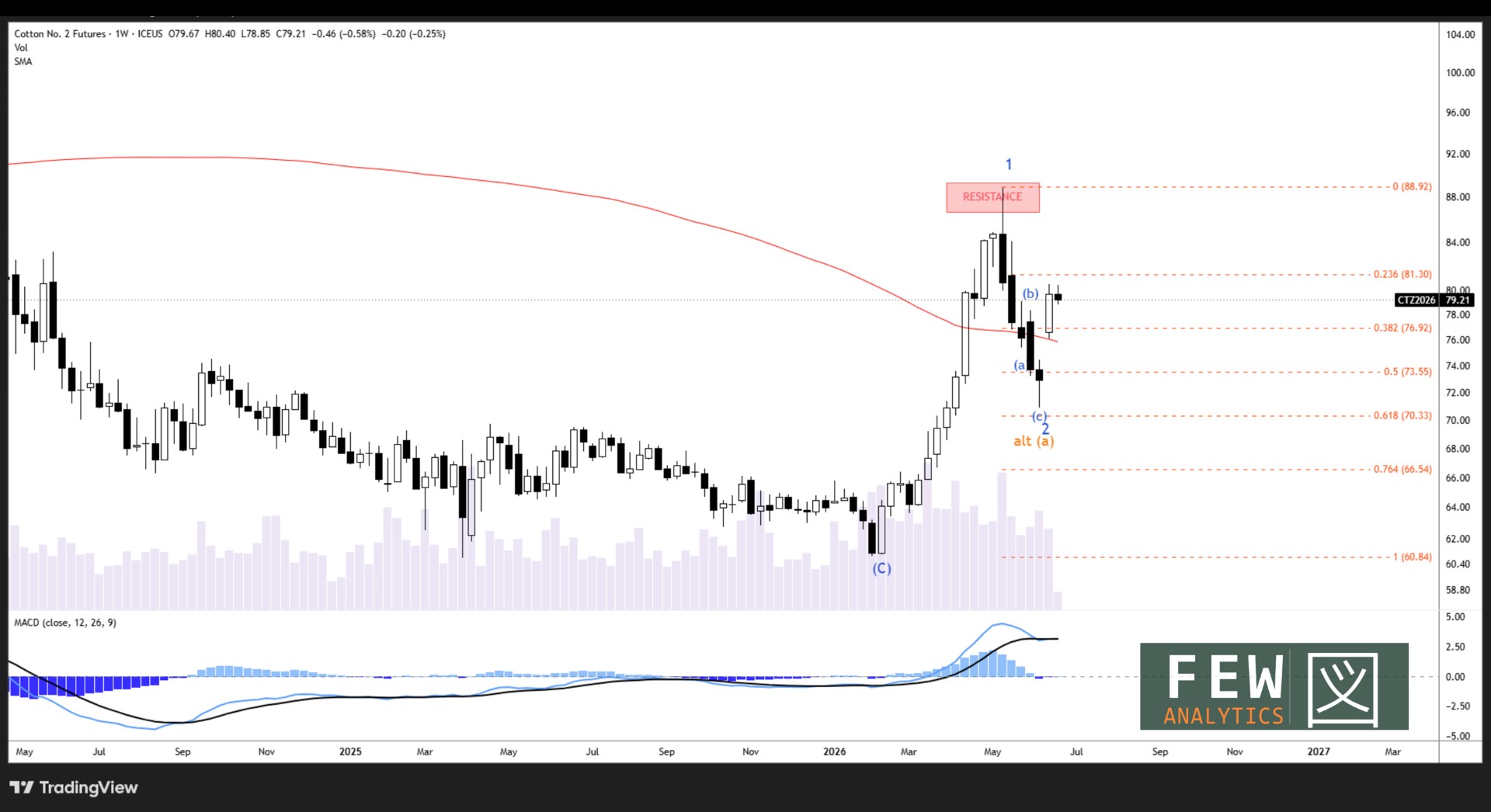
CT fell back to the 0.618 retracement of the entire 2026 rally in recent weeks. Once that 70 target was acquired, a multi-week rally has ensued. This bodes well for the bottom being completed in wave 2, and offers the first indications that we may have a macro wave 3 on our hands in cotton. We must exercise caution, however, as clean macro impulses are rare in commodity charts, and a wave 3 target would sit much higher than the 89 peak reached in 2026 thus far. We remain vigilant for signs that such a bullish base case may prove incorrect.
Tactical
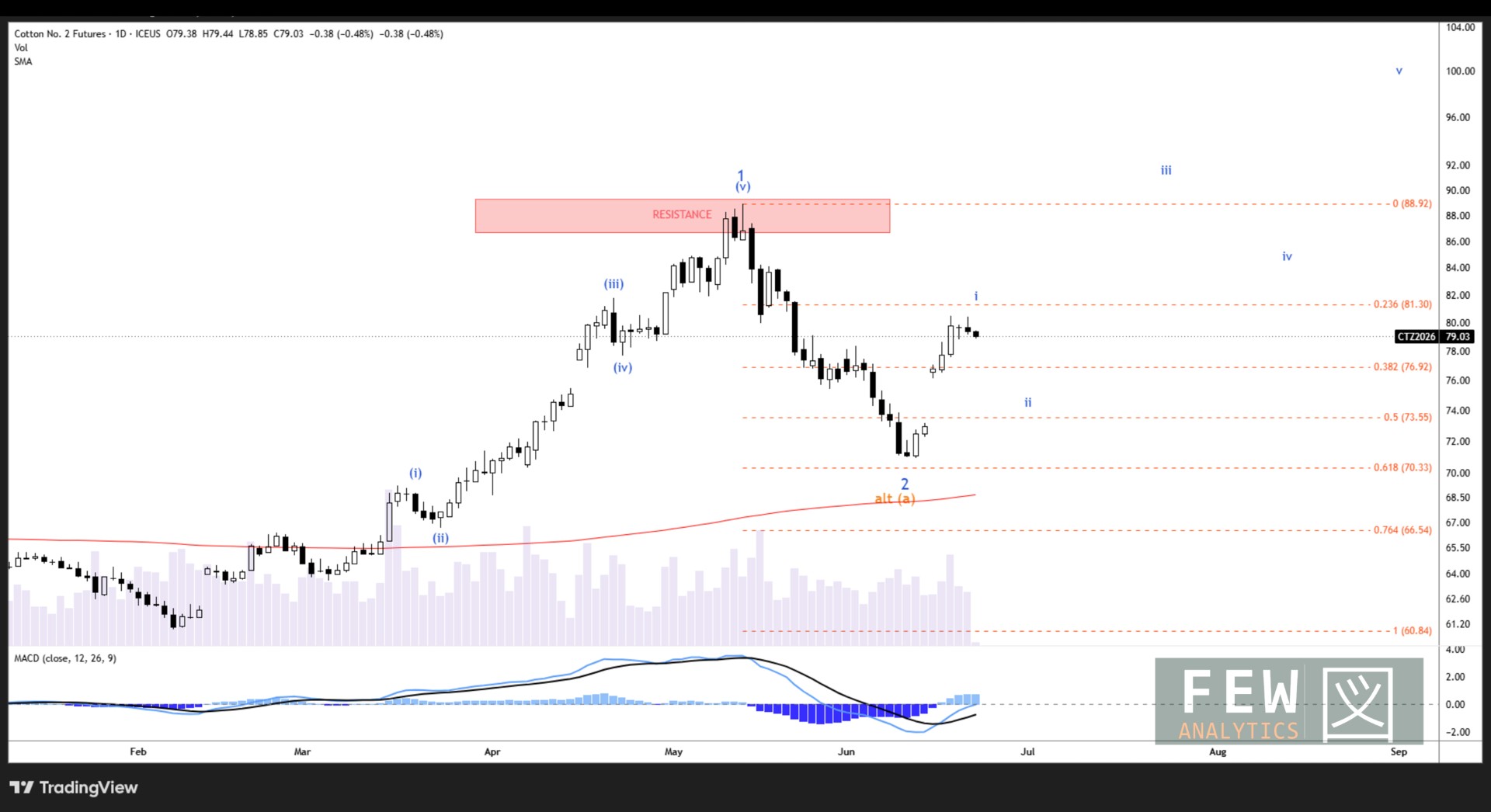
In the short term, cotton continued higher in impulsive fashion, extending its advance off the 70 target region. There is a good chance we now have a small-degree five waves up in place for wave i, which would call for a corrective wave ii before the next leg higher. It remains possible to push a touch higher before the top is in, so we are not ruling out a marginal new high to complete the count. Either way, what’s important is that we are approaching a solid buy opportunity once this rally retraces at least 50%, offering a low-risk entry into what we expect to be the early stages of a big move higher.
Cotton Positioning
CFTC data for 16 June showed managed money holding 63,415 longs and 28,279 shorts, leaving a net long of 35,136 contracts. That was down 7,068 contracts from 42,204 the previous week.
The reduction was split between long liquidation and fresh short selling: funds cut longs by 3,071 contracts and added 3,997 shorts. Positioning therefore turned moderately more bearish, although funds remain clearly net long.
Commercial accounts held 71,040 longs and 184,937 shorts, leaving them net short 113,897 contracts, only 530 contracts more bearish week on week. Commercial longs fell by 15,294, while shorts declined by 14,764.
Gross commercial shorts remain large at 43.3% of open interest, but the latest move reflected reduced exposure rather than renewed hedge selling. Total open interest fell by 55,142 contracts to 427,110, pointing to broad position liquidation.

Balance sheet
USDA’s U.S. cotton balance remains heavy, although the June WASDE was modestly more supportive than the May baseline. For 2025/26, USDA held production at 13.90 million bales, raised exports to 12.20 million bales, lowered domestic use to 1.55 million bales and reduced ending stocks to 4.20 million bales. This leaves stocks-to-use near 30.5%. For 2026/27, production, exports and domestic use were unchanged at 13.30 million, 12.30 million and 1.60 million bales, respectively, while ending stocks fell to 3.70 million bales due to the smaller old-crop carry-in. New-crop stocks-to-use consequently declined to about 26.6%. The lower carryout is supportive, and USDA continues to forecast a 2026/27 farm price of 73 cents/lb, compared with 63 cents/lb in 2025/26. Nevertheless, supplies remain too comfortable to generate a sustained rally without additional support from weather or demand.
USDA’s forecast already incorporates significant abandonment. The June balance sheet retains 9.64 million planted acres and 7.38 million harvested acres for 2026/27, implying that roughly 23.4% of planted area will not be harvested. Harvested acreage is based on 10-year regional abandonment averages, with the Southwest adjusted for current moisture conditions. As a result, West Texas dryness alone may not be enough to materially tighten the balance sheet; the market will need evidence that stands and yield potential are deteriorating beyond USDA’s existing assumptions.
The global outlook became more constructive in June. USDA projects 2026/27 world production at 116.04 million bales, below consumption of 121.76 million bales, with ending stocks declining to 71.13 million bales from 76.63 million bales in 2025/26. However, Brazil remains a formidable export competitor, with 2026/27 production forecast at 17.50 million bales and exports at 15.00 million bales.
U.S. export demand improved across both sales and shipments. Latest old-crop upland sales reached 207,000 running bales, up 12% from the previous week and 60% above the four-week average, led by Vietnam, Pakistan, India and Indonesia. New-crop sales were particularly strong at 298,700 running bales, primarily to Vietnam, Nicaragua, Turkey and Mexico. Shipments rose to 300,100 running bales, up 12% week over week and 3% above the four-week average.
Planting Progress
USDA/NASS’s latest Crop Progress report shows U.S. cotton planting nearing completion, although it remains modestly behind normal. As of the week ended June 21, the crop was 92% planted, up from 86% a week earlier and ahead of last year’s 91%, but below the 5-year average of 94%. Texas reached 90% planted, up from 80%, matching last year and two percentage points behind the 92% average.
Crop development remains broadly on schedule. Nationally, 27% of the crop was squaring, up from 19% and ahead of both last year and the 5-year average at 25%. Texas was 25% squaring, up from 20%, matching last year and ahead of the 23% average. Boll setting reached 5% nationally and 8% in Texas, with both readings matching last year and their respective 5-year averages.

Condition Report
The national condition rating improved at the top end, although the weakest category also expanded. U.S. cotton was rated 53% good/excellent, up from 50% last week and above last year’s 47%. Fair fell to 34% from 39%, while poor/very poor increased to 13% from 11%, although that remains well below last year’s 20%.
Texas was rated 44% good/excellent, up from 42%, while fair declined to 36% from 43%. Poor/very poor increased more sharply to 20% from 15%. The national headline is constructive, but the Texas distribution became more polarized rather than uniformly better.

US Cotton Export & Sales
For the week ended June 11, 2025/26 upland net sales totaled 177,100 RB, down 15% from the prior week but 5% above the four-week average. Pakistan was the largest buyer at 76,600 RB, followed by India at 39,600 RB, Vietnam at 21,000 RB, China at 11,400 RB and Taiwan at 7,400 RB.
Upland exports fell to 251,000 RB, down 16% week over week and 15% below the four-week average. Pima exports totaled 13,200 RB, down 43% from the previous week but still 11% above the four-week average.
On a 480-pound statistical-bale basis, all-cotton shipments totaled 272,100 bales, lifting cumulative exports to 10.107 million bales. That remains about 106,000 bales behind last year. Total current-crop commitments stand at 12.563 million bales, approximately 363,000 bales above USDA’s 12.2 million-bale export forecast.

Shipments also improved. Upland exports increased to 300,100 RB, while Pima exports hit a marketing-year high of 22,900 RB. All-cotton shipments totaled 332,700 bales, lifting cumulative shipments to 9.84 million bales, still slightly behind last year but now moving at a pace supportive of USDA’s target.
USDA raised its old-crop U.S. cotton export forecast to 12.2 million bales. To reach that level, shipments need to average roughly 295,000 bales per week through the end of the crop year. This week’s shipment pace was comfortably above that threshold, adding some cushion.
New-crop demand was notably stronger. 2026/27 upland sales jumped to 298,700 RB, led by Vietnam, Nicaragua, Turkey, Mexico and unknown destinations. All-cotton new-crop commitments reached 2.26 million bales, with the forward book still concentrated but improving.

USDA raised its old-crop U.S. cotton export forecast to 12.2 million bales. To reach that level, shipments need to average roughly 295,000 bales per week through the end of the crop year. This week’s shipment pace was comfortably above that threshold, adding some cushion.
New-crop demand was notably stronger. 2026/27 upland sales jumped to 298,700 RB, led by Vietnam, Nicaragua, Turkey, Mexico and unknown destinations. All-cotton new-crop commitments reached 2.26 million bales, with the forward book still concentrated but improving.

Texas topsoil rated short or very short increased to 42% from 39%, while subsoil short or very short increased to 48% from 45%. Nationally, topsoil short or very short improved to 31% from 33%, while subsoil improved to 36% from 37%.
The latest U.S. Drought Monitor shows 40.1% of Texas in D1-D4 drought, down from 41.3% previously. Severe drought or worse declined to 16.7% from 17.7%. Rainfall of 2 to 6 inches supported improvement across southern and eastern Texas, while 2 to 4 inches brought limited relief to the northeastern Texas Panhandle.
CPC’s latest 6-10 day outlook, covering June 29 through July 3, places North, South and West Texas in the above-normal temperature category, with precipitation near the seasonal median. Forecast confidence is 4 out of 5.
The 8-14 day outlook, covering July 1 through July 7, maintains above-normal temperatures across Texas. North Texas shifts into the below-median precipitation category, while South and West Texas remain near median. Confidence is 3 out of 5.
NHC currently reports no active Atlantic tropical cyclones and does not expect tropical cyclone formation across the Atlantic, Caribbean or Gulf during the next seven days.

Cotton On-Call
No major outlier in the latest Cotton On-Call report, other than the same issue as last week: a large number of unfixed call purchases remain concentrated in the new-crop December 2026 contract.

Outlook for Cotton
Bull Case
West Texas remains the key upside risk. Around 76% of U.S. cotton area remains in drought. Hotter, drier forecasts could quickly lift abandonment and yield concerns.
USDA stocks are supportive. U.S. ending stocks are projected at 3.7 million bales, while world stocks fall to 71.1 million bales.
New crop export sales improved. Sales reached 188,400 RB, showing broader forward demand.
Bear Case
Rain is the main bearish trigger. Broad West Texas rainfall would reduce weather premium quickly.
Crop progress remains normal. U.S. planting is 92% complete, with Texas at 90%.
Crop ratings improved. National good or excellent ratings rose to 53%. Texas stands at 44%, with 20% poor or very poor.
Exports remain soft. Shipments fell to 251,000 RB, down 16% on the week
Base Case
Cotton remains a weather market.
December support is 77 to 78 c/lb, then 75 to 76 c/lb. Resistance is 80 to 81 c/lb, then 82 c/lb.
Bias this week: neutral to slightly constructive. Bullish if West Texas stays dry or crop ratings weaken. Bearish if rainfall improves and December breaks below 77 c/lb
Coffee
Coffee Price Action
Coffee’s front end has split: arabica front U/Z spread has rallied to +14slac, while robusta is easing. September arabica settled 275.95, up 8.95 (3.35%), while July closed 287.95, leaving a 12.00-cent inverse with just 1,106 lots open. ICE arabica stocks fell to 392,901 bags, a 2.25-year low. Robusta settled $3,580, down $89 on the week, with certified stocks recovering to 4,032 lots.
Positioning shows the first leg was mainly short-covering. Managed-money net length rose to 14,007 contracts as shorts fell by 2,875. Brazil remains the trigger and the cap: rain is slowing harvest and raising quality risk, but Safras still had harvest at 39%, while USDA’s record 71.9m-bag crop and Rabobank’s 9.5m-bag arabica surplus limit deferred upside.
Vietnam keeps robusta bearish near-term, with Jan–May exports up 7.9% and production projected at 29.4m bags. El Niño is the medium-term risk, not yet a confirmed supply loss.
Technical Analysis:
Strategic
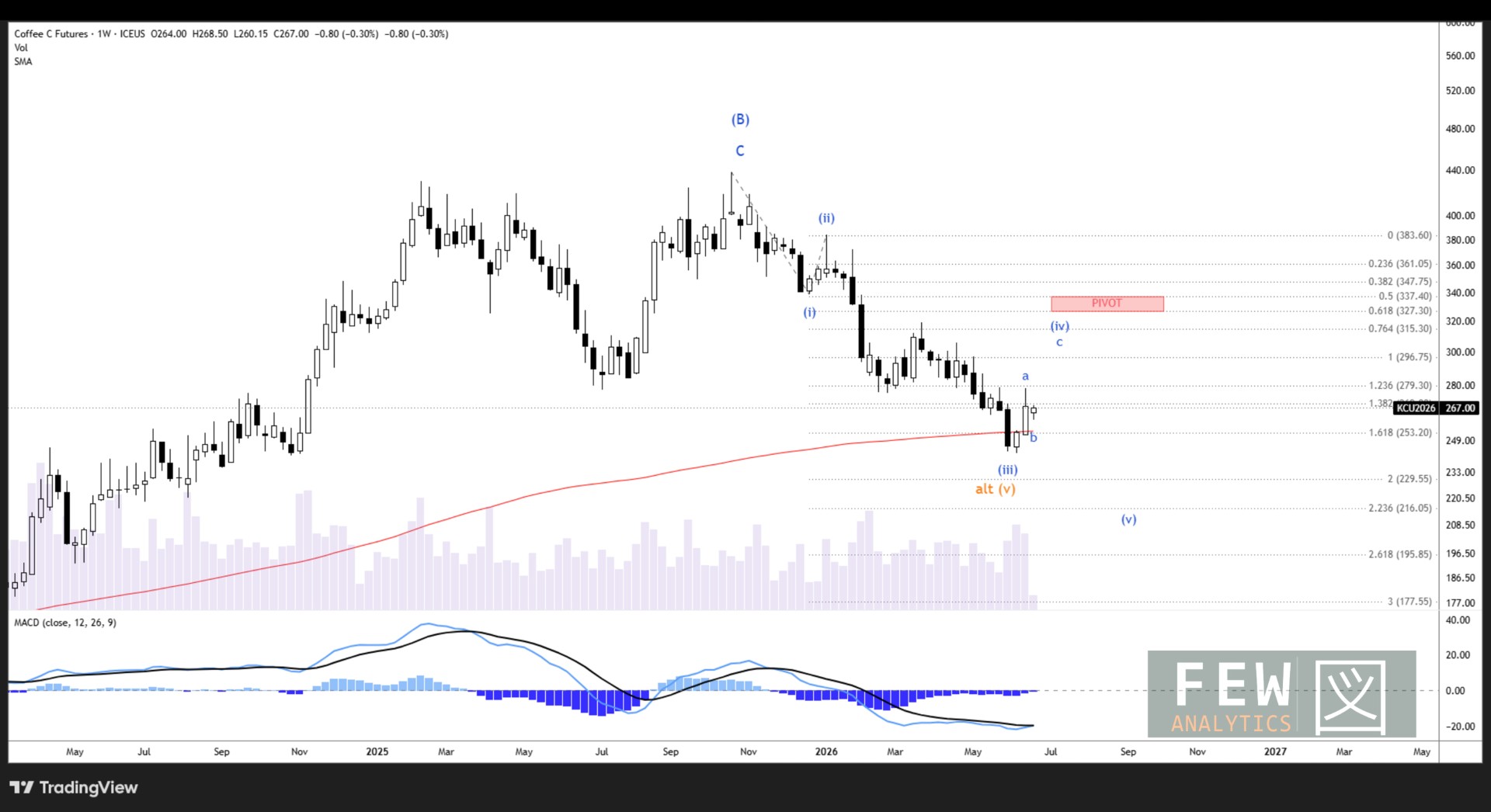
Arabica continues to follow the path set out in prior GSX commentary, within macro wave (C) lower. Action over the past week aligns to our base case as this being wave (iv) up, leaving the alternate scenario — a larger degree bottom in alt (v) — less probable. From here we expect KC to chop higher towards 300 before commencing the wave (v) decline toward 215.
Tactical
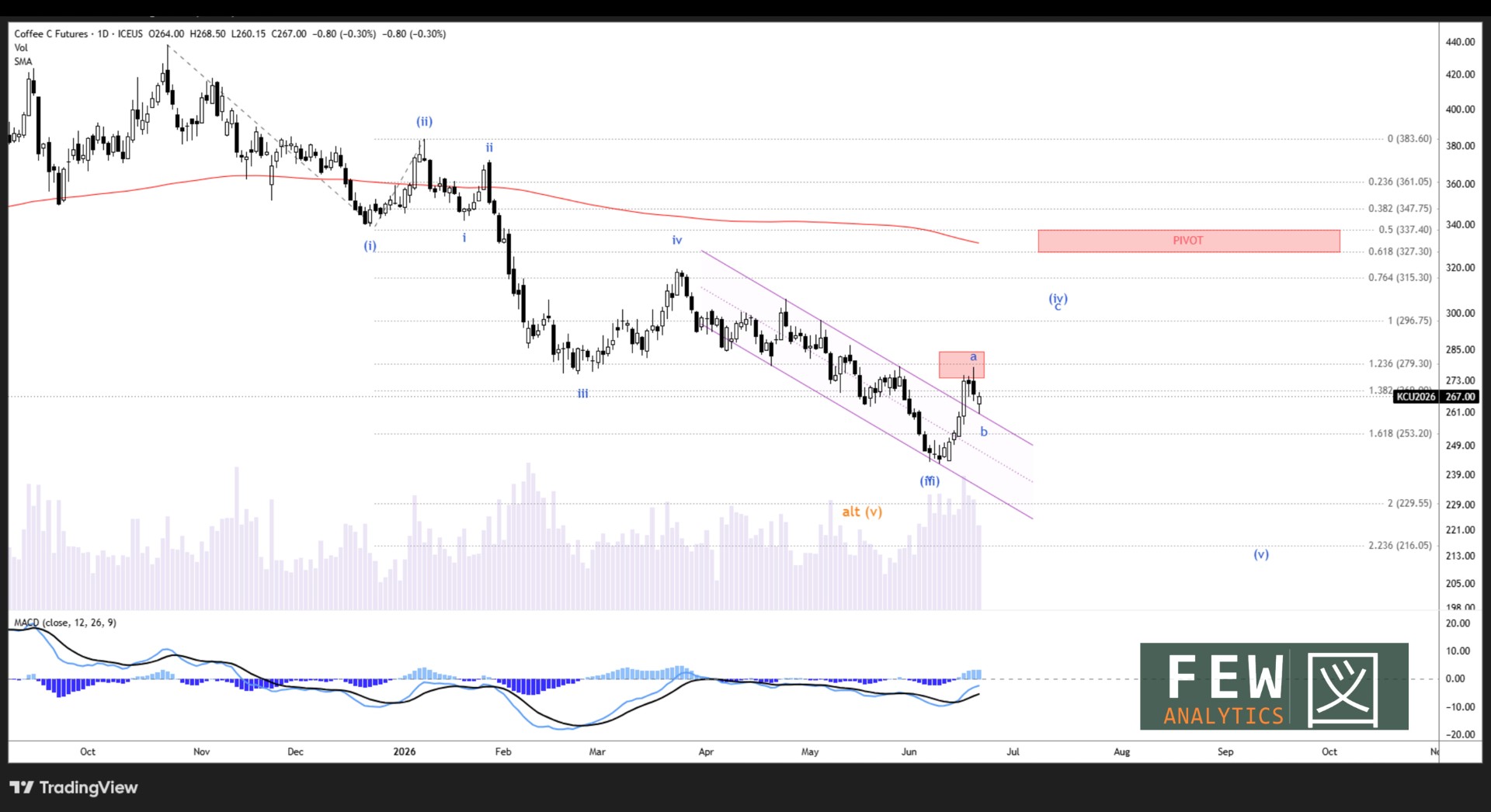
Over the week KC delivered the breakout from the downtrend channel outlined in last edition’s tactical notes. We also saw a clean rejection from our red resistance box at 280, playing out cleanly as waves a and b. Thus far the b-wave has found support at the top of our channel. With those moves in the bag, we can fairly confidently project wave c of (iv) toward the 295–300 target, using Fibonacci confluence in that region.
Physical Pricing
Brazil differentials: We have rolled off the old-crop differentials, and Fine Cup differentials for September and December now stand at -6 over September and -6 over Dec-26, respectively. This is a positive signal for the market outlook.

Certified stocks: have slide ~50k bags for Arabica and for Robusta and they have declined around ~70k bags in the last month


Coffee Positioning:
Arabica’s fund cushion remains thin, although it rebuilt during the week. Managed money held 35,526 longs and 27,552 shorts, leaving a net long of 7,974 contracts, up 4,841 contracts from roughly 3,133 the previous week.
The increase was driven almost entirely by short covering. Funds cut longs by 398 contracts but reduced shorts by 5,239, making the move less bullish than the headline net increase suggests.
Commercial accounts held 58,018 longs and 67,533 shorts, leaving them net short 9,515 contracts, compared with 6,884 the previous week. Commercial longs fell by 14,693, while shorts declined by 12,062, widening the net short by 2,631 contracts.
Open interest dropped by 39,313 contracts to 233,201, confirming broad position reduction. The commercial signal is mixed: gross short exposure declined, but the net position became more bearish.


Outlook:
Bull Case
Nearby tightness remains live. Arabica stocks are only 396,171 bags after July FND. Robusta FND is June 25, keeping squeeze risk elevated.
Brazil rain adds quality premium. Harvest delays and drying problems remain supportive for nearby arabica.
Positioning remains light. Spec net length was only 4,710 contracts, leaving room for further short covering.
Bear Case
Brazil’s record crop caps rallies. USDA forecasts 71.9 million bags, while private estimates reach about 75.7 million.
Robusta remains heavier. Vietnam output is forecast at 32.5 million bags, while certified stocks recovered to 3,991 lots.
The chart still needs repair. September arabica closed at 275.95 c/lb, below the key 280 to 285 c/lb resistance zone.
Base Case
Coffee remains tight nearby and looser forward.
Support is 267 to 270 c/lb, then 255 to 260 c/lb. Resistance is 280 to 285 c/lb, then 300 c/lb.
Bias this week: two-sided to slightly firm. Respect squeeze risk through robusta FND on June 25. Turn defensive below 267 c/lb.


